
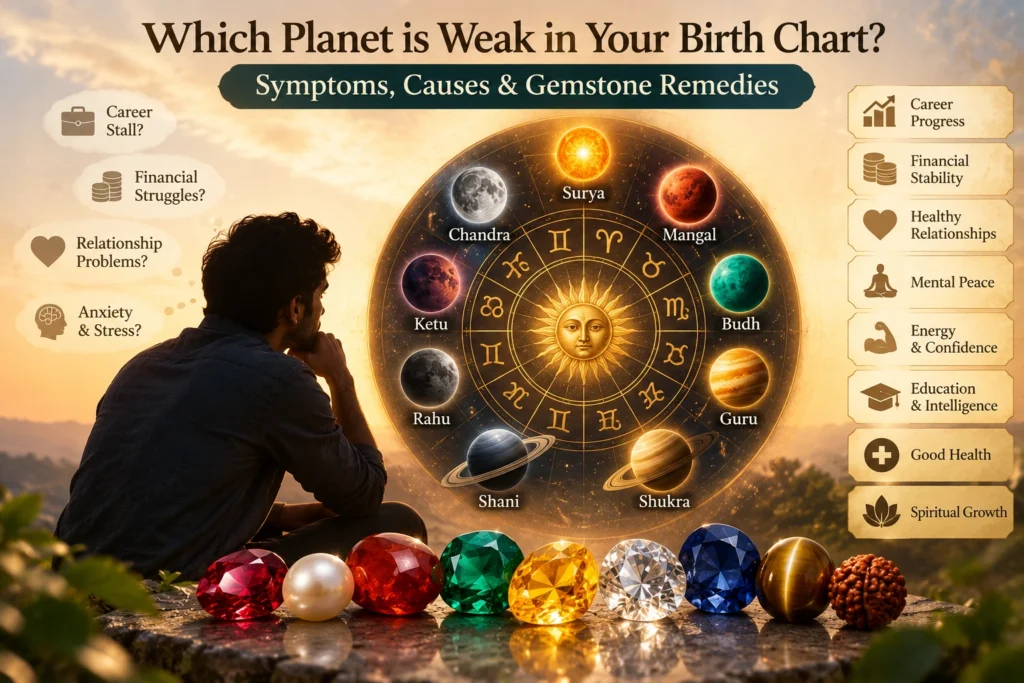
Most people who come to Vedic astrology for the first time come with a specific life problem. The career that stalls despite genuine effort. The relationships that keep following the same disappointing pattern. The anxiety that persists despite nothing being objectively wrong. The financial struggle that seems disproportionate to the hours and intelligence being invested. These persistent, recurring patterns often have a planetary cause: a weak, debilitated, or afflicted Navagraha whose specific area of governance is producing the difficulties being experienced. Identifying which planet is weak and addressing it with the correct gemstone or crystal remedy is one of the most practical applications of Vedic astrology for everyday life.
This guide covers what makes a weak planet in birth chart, how to identify which planet is most likely causing a specific life difficulty, and which gemstone or crystal remedy addresses it most directly.
What Makes a Weak Planet in Birth Chart
Several chart conditions reduce a planet’s ability to deliver its positive results. Understanding these helps in identifying which planet is likely responsible for a recurring life challenge.
Debilitation (Neecha): Every planet has one sign in which it is at its weakest, called its debilitation or Neecha sign. A debilitated planet struggles to express its positive qualities and tends to produce the more difficult dimensions of its domain. The nine debilitation signs are: Surya debilitated in Tula (Libra), Chandra in Vrischika (Scorpio), Mangal in Karka (Cancer), Budh in Meen (Pisces), Guru in Makar (Capricorn), Shukra in Kanya (Virgo), and Shani in Mesh (Aries). Finding one of your planets in its Neecha sign is a strong indicator of why that planet’s life domains are consistently difficult.
Dusthana house placement: The 6th, 8th, and 12th houses are called Dusthanas, houses of difficulty, obstacle, and loss. A planet placed in one of these houses by the Ascendant calculation gives its results through struggle, delay, and obstacle rather than freely and easily. The 6th house specifically indicates competition and health challenges for that planet’s domain; the 8th indicates transformation through disruption; the 12th indicates loss, isolation, and the expenses associated with that planet’s governance.
Combustion (Astangata): When a planet is within a specific degree range of Surya (the Sun) in the birth chart, it is said to be combust or burned by the Sun’s intensity. A combust planet loses its independent ability to produce results; its significations become overwhelmed by Surya’s energy and express themselves through the Sun’s lens rather than their own nature.
Conjunction with malefic planets: Natural malefic planets including Shani (Saturn), Rahu, Ketu, and Mangal (Mars) can diminish the positive qualities of planets they conjoin, particularly in close degree conjunction. A well-placed Guru (Jupiter) conjoined with Rahu, for example, can produce confusion, excess, and the distortion of Jupiter’s wisdom rather than its clear and generous natural expression.
Enemy sign placement: Each planet has signs it rules (own sign), signs it treats as friendly, and signs it treats as enemies. A planet in an enemy sign operates with friction and difficulty, unable to express its nature comfortably in the sign’s environment.
Life Symptoms to Planet Mapping
The most accessible way to identify a potentially weak planet is to look at which area of life is most persistently, consistently, and disproportionately difficult. The following table maps common life difficulties to their most likely planetary cause.
| Life Area Affected | Likely Weak Planet | Specific Signs to Look For |
|---|---|---|
| Confidence, authority, career recognition, government | Surya (Sun) | Feeling overlooked despite genuine ability; poor relationship with father; difficulty with authority figures; health issues in heart or eyes |
| Mental peace, emotions, sleep, mother | Chandra (Moon) | Chronic anxiety; sleep disturbance; emotional volatility; troubled maternal relationship; sensitivity to Moon phases |
| Energy, courage, ambition, siblings, blood health | Mangal (Mars) | Low physical energy; lack of decisive courage; frequent accidents or injuries; conflicts with siblings; blood-related health issues |
| Intelligence, communication, business, education | Budh (Mercury) | Difficulty in studies; poor business judgment; nervous system issues; communication that consistently misses its mark; skin problems |
| Wealth, opportunity, wisdom, children, marriage for women | Guru (Jupiter) | Financial struggle despite hard work; difficulty having children; poor opportunities appearing; weight gain; liver health issues |
| Love, relationships, beauty, creative expression, marriage | Shukra (Venus) | Recurring relationship disappointments; difficulty in marriage; poor creative output; kidney health; lack of material comfort |
| Career discipline, long-term success, legal matters, service | Shani (Saturn) | Career instability; chronic delays; legal difficulties; persistent hard work without proportional reward; joint pain |
| Sudden events, confusion, obsession, foreignness | Rahu (North Node) | Inexplicable sudden reversals; obsessive thinking; confusion about identity and values; difficult foreign experiences |
| Spiritual depth, detachment, mysterious illness, past patterns | Ketu (South Node) | Sudden unexplained losses; mysterious health issues; feeling spiritually disconnected; strong pull toward isolation |
Planet to Gemstone Remedy: Complete Reference
Once a weak planet has been identified through birth chart assessment, the appropriate gemstone or crystal remedy addresses it at two levels. The Nav Ratan (primary planetary gemstone) provides the most direct and potent planetary correction for appropriate Lagna placements, requiring Jyotishi confirmation before purchase. The Upratna (crystal substitute) provides accessible daily support that is safe for all Rashis without formal prescription.
| Weak Planet | Nav Ratan Gemstone | Crystal Upratna (Safe for All) | Wearing Day |
|---|---|---|---|
| Surya (Sun) | Manik (Ruby) | Tiger Eye (Vyaghra Mani), Red Garnet | Sunday (Ravivar) |
| Chandra (Moon) | Moti (Pearl) | Moonstone (Chandrakant Mani), Milky Quartz (Dudhi Sphatik) | Monday (Somvar) |
| Mangal (Mars) | Moonga (Red Coral) | Carnelian, Red Jasper (Lal Jaspar) | Tuesday (Mangalvar) |
| Budh (Mercury) | Panna (Emerald) | Lapis Lazuli, Green Aventurine | Wednesday (Budhvar) |
| Guru (Jupiter) | Pukhraj (Yellow Sapphire) | Citrine (Sunela) | Thursday (Guruvar) |
| Shukra (Venus) | Heera (Diamond) or Safed Pukhraj | Rose Quartz (Gulab Sphatik), Green Aventurine | Friday (Shukravar) |
| Shani (Saturn) | Neelam (Blue Sapphire) | Amethyst (Jamunia), Black Hakik (Black Agate) | Saturday (Shanivar) |
| Rahu (North Node) | Gomed (Hessonite Garnet) | Black Tourmaline, Hematite | Saturday (Shanivar) |
| Ketu (South Node) | Lehsunia (Cat’s Eye) | Black Obsidian, Black Tourmaline | Wednesday (Budhvar) evening |
How to Use This Information Safely
Two clear rules apply to anyone using this guide to self-identify a weak planet and seek a remedy.
The first rule: Crystal Upratnas (the right column in the table above) are safe to begin wearing immediately for all Rashis without any Jyotishi consultation. If you suspect a weak Chandra from the symptom list and want to begin supportive crystal work while arranging a proper chart assessment, wearing a Moonstone or Milky Quartz bracelet is beneficial and carries no risk of adverse effects. The same applies for all the crystal Upratna options in the table. Begin with the crystal; arrange the formal consultation for the Nav Ratan.
The second rule: Never purchase a Nav Ratan gemstone (Manik, Moti, Moonga, Panna, Pukhraj, Heera, Neelam, Gomed, or Lehsunia) without Jyotishi confirmation that it is appropriate for your specific Lagna and chart placement. The life-symptom-to-planet mapping in this guide identifies likely planetary candidates, not confirmed prescriptions. A planet that appears weak through life symptoms may actually be producing those effects through a different mechanism in the chart, and the correct Nav Ratan for your situation may be for a different planet entirely. The formal chart assessment makes this determination accurately in a way that self-diagnosis from symptoms alone cannot.
The Mahadasha Shortcut for Identifying a Weak Planet
One of the most reliable indicators of a challenging planetary placement is looking back at which Mahadasha (planetary period) was the most difficult in your life so far. If Shani Mahadasha produced 19 years of career instability, chronic delay, and legal difficulty beyond what would be expected for most Shani periods, it is a strong indicator that Shani is challenged in your chart. If Chandra Mahadasha produced exceptional emotional turbulence, sleep disruption, and family difficulty, it points to a challenging Moon placement. The Mahadasha that felt most difficult in retrospect is often the planet most worth addressing through gemstone or crystal remedy in the current period.
For a complete explanation of the Mahadasha system and how to identify which period you are currently in, the What Is Mahadasha complete guide covers the full Vimshottari Dasha system in detail.
Frequently Asked Questions
How do I find my weak planet without knowing astrology?
The most accessible starting point is the life symptom mapping in this guide. Identify the one area of life that has been most consistently and disproportionately difficult across many years, find the corresponding planet in the symptom table, and start with the safe crystal Upratna for that planet while arranging a proper Jyotishi consultation. This is not the same as a formal chart assessment, but it gives you a starting point for crystal support while the more accurate diagnosis is being prepared. The free Janmpatri consultation at Sawariya Gems provides chart-based assessment from your actual birth details.
Can I have more than one weak planet?
Yes, and this is more common than having a single isolated weak planet. Birth charts regularly show more than one planet in challenging conditions, which is why people often experience difficulties across multiple areas of life simultaneously. In practice, the Jyotishi’s assessment identifies which weak planet is most responsible for the current period’s primary challenges (often determined by the current Mahadasha lord) and prescribes remedies in order of priority rather than attempting to address all weak planets simultaneously. Attempting to wear gemstones for multiple planets at once without expert guidance creates a complex and sometimes conflicting energetic field.
How long does it take for a gemstone remedy to correct a weak planet?
Crystal Upratna bracelets typically produce noticeable shifts in the areas they address within two to six weeks of consistent daily wearing. Nav Ratan gemstones produce faster and more potent results: many Jyotishis describe initial effects within 72 hours for Neelam (Blue Sapphire), and most Nav Ratans show meaningful results within two to three months of correct wearing. The depth of correction depends on how severely the planet is challenged in the chart and how accurately the remedy is matched to the specific need. A perfectly prescribed Nav Ratan for a genuinely debilitated planet in the appropriate Mahadasha can produce dramatic life improvements; a poorly matched prescription produces minimal change or negative effects.
Is a debilitated planet always bad?
No, and this nuance is important. Classical Vedic astrology includes the concept of Neecha Bhanga (cancellation of debilitation), where specific chart conditions cancel or significantly reduce the negative effects of a debilitated planet, sometimes transforming it into an unusually powerful placement. The conditions for Neecha Bhanga are specific and depend on the positions of other planets in the chart. This is another reason why formal chart assessment matters: what appears to be a clearly weak debilitated planet in isolation may have Neecha Bhanga conditions that change the remedy approach entirely. Never assume a debilitated planet will produce its difficult results in every chart; always get the full picture assessed.
My Jyotishi said I have a weak Guru. Which is better, Pukhraj or Citrine?
Pukhraj (Yellow Sapphire) provides the most direct and potent correction for a weak Guru confirmed by Jyotishi assessment, operating at the Nav Ratan level of chart-specific planetary remedy. Citrine (Sunela) provides gentle, safe, daily Solar Plexus and Guru energy support accessible without prescription. If your Jyotishi has confirmed Pukhraj is appropriate for your Lagna and chart, Pukhraj is the stronger remedy and Citrine can be worn alongside it as a complementary daily bracelet. If you are waiting to source quality certified Pukhraj or are still in the process of confirming the prescription, Citrine as a bracelet provides genuine interim Guru support. The detailed comparison of the two stones is covered in the Pukhraj vs Citrine guide.
For a complete chart assessment identifying your weak planets, the specific gemstone remedies appropriate for your Lagna and current Mahadasha, and personalised guidance on whether Nav Ratan or crystal Upratna is more appropriate for your situation, use the free Janmpatri consultation at Sawariya Gems.
This guide is for educational purposes based on Vedic Jyotish tradition. Identifying a weak planet from life symptoms provides a starting point for investigation, not a definitive diagnosis. Nav Ratan gemstone prescription must always be confirmed by a qualified Jyotishi based on the complete birth chart.