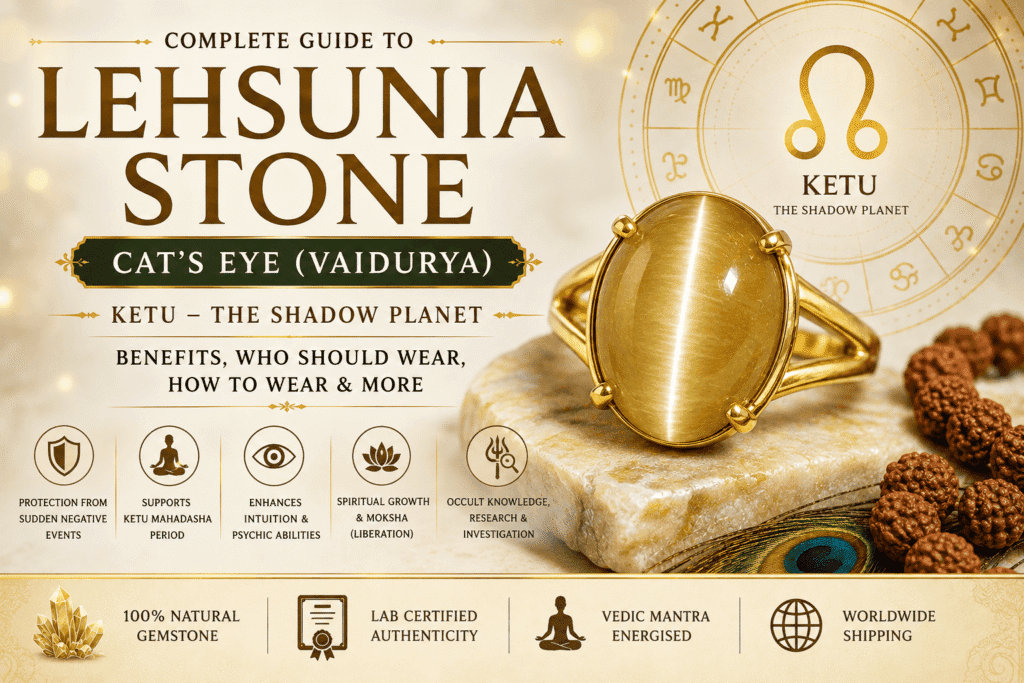
Lehsunia (Cat’s Eye), known in Sanskrit as Vaidurya (Chrysoberyl), is the most mysterious gemstone in the Nav Ratan system. Every other sacred stone is a straightforward mineral that grows in the earth. Lehsunia is identified not just by what it is made of, but by what it does in light: a silky, luminous band appears to float and move across the stone’s surface when it is turned, like an eye opening and closing. This effect, called chatoyancy, is what makes a Chrysoberyl stone astrologically active as Lehsunia. Without it, the stone is simply a mineral. With it, it becomes Ketu’s (the South Node’s) most powerful planetary instrument in the gemstone kingdom.
Ketu is one of Vedic astrology’s most complex and least understood planetary forces. It is a Chhaya Graha (shadow planet), not a physical celestial body, but a mathematical point in space where the Moon’s orbit intersects the ecliptic. What Ketu governs is correspondingly subtle: past-life karma, spiritual liberation (Moksha), psychic sensitivity, occult knowledge, sudden and unexpected events, detachment from the material world, and the deep karmic patterns that shape a life from beneath the surface. Wearing Lehsunia strengthens Ketu’s protective dimension while calming its capacity for sudden disruption.
What Ketu Governs in Vedic Astrology
Understanding Lehsunia’s benefits requires understanding Ketu’s domain, which is genuinely unusual among the nine Navagrahas. Unlike most planets that govern straightforward areas of life (Shani governs career and discipline, Chandra governs the mind and mother, Guru governs wisdom and abundance), Ketu governs the areas of life that operate beneath ordinary awareness.
Ketu rules past-life karma and the unresolved patterns from previous incarnations that influence this life. It governs psychic sensitivity, the sixth sense, and all forms of occult, investigative, and research-oriented intelligence. It rules sudden events of all kinds: sudden gains, sudden losses, accidents, and unexpected turns. Ketu is associated with the grandfather, with dogs, with wounds and injuries, with mysterious illnesses that have no obvious cause, and with the impulse toward Moksha (spiritual liberation) that pulls a person away from material attachment toward something larger.
When Ketu is well-placed and strong in a birth chart, it produces extraordinary intuitive intelligence, spiritual depth, research and investigative ability, and the capacity to see through surface appearances to what is genuinely real. When Ketu is afflicted or poorly placed, it produces the disruptive dimension of the shadow planet: unexpected losses, accidents, hidden enemies, mysterious health issues, and a sense of confusion or disconnection from the material world that makes practical life genuinely difficult.
Lehsunia strengthens Ketu’s protective and positive qualities while providing a stabilising energetic field against its disruptive ones. It is specifically powerful during Ketu Mahadasha, the 7-year period when Ketu’s energy dominates the chart and when the full complexity of this planet becomes the primary life experience.
Lehsunia Stone Benefits in Vedic Astrology
Protection from sudden negative events is the most immediately practical Lehsunia benefit and the one most commonly cited in classical Jyotish texts. Ketu’s disruptive capacity includes accidents, hidden enemies, sudden financial losses, and unexpected events that seem to come from nowhere. A correctly prescribed and worn Lehsunia creates a protective energetic field that specifically mitigates these Ketu-type sudden disruptions without suppressing the positive sudden events (unexpected good fortune, windfall gains, and sudden opportunities) that a strong Ketu also produces.
Ketu Mahadasha support is the primary clinical application of Lehsunia. The 7-year Ketu Mahadasha is one of the most internally transformative periods in the Vimshottari Dasha system. It strips away what is no longer genuinely needed, forces confrontation with karmic patterns that have been operating unconsciously, and creates the conditions for genuine spiritual development, but it does all of this through disruption, loss, and the dissolution of structures that felt permanent. Wearing Lehsunia during Ketu Mahadasha does not prevent this transformation; it provides the protective and grounding support that allows the person going through it to navigate the period without being overwhelmed by its more destabilising effects.
Spiritual development and psychic sensitivity are enhanced by a strong Ketu, and Lehsunia amplifies this dimension of the planet’s energy. People who wear Lehsunia consistently often report heightened intuitive awareness, more vivid and meaningful dreams, a clearer sense of their past-life karmic patterns, and a deepened meditation practice. These effects are not universal and depend on the specific Ketu placement in the chart, but they are consistently reported among wearers for whom Lehsunia is correctly prescribed.
Research, investigation, and occult knowledge fall under Ketu’s domain, and strengthening Ketu through Lehsunia supports these capacities directly. Astrologers, researchers, investigators, surgeons, and practitioners of any healing or investigative discipline often find Lehsunia particularly resonant with their professional practice.
Protection from Nazar (evil eye) and negative energies is one of Lehsunia’s most traditional roles in Indian gemological culture. The stone’s unusual “eye” appearance carries a deep visual symbolism of watchfulness and psychic protection, and its astrological connection to Ketu, the planet most associated with hidden and occult forces, makes it a traditionally powerful protective stone against precisely these influences.
Mysterious illness and hidden health issues governed by Ketu, including skin conditions, neurological issues, and illnesses without obvious causes that standard diagnosis struggles to identify, often respond to Ketu-strengthening through Lehsunia. In Ayurvedic Jyotish, Ketu governs these mysterious health dimensions, and a well-prescribed Lehsunia can support recovery and clarity in health areas where the conventional picture remains puzzling.
Who Should Wear Lehsunia
Lehsunia is most clearly indicated for anyone currently running Ketu Mahadasha (the 7-year period in the Vimshottari Dasha system). This is the most universal and widely agreed-upon prescription for Lehsunia across all Jyotish schools. Regardless of Lagna, if Ketu Mahadasha is active and Ketu is placed in a position to give benefits (not in a dusthana house or severely afflicted), Lehsunia is the most effective support gemstone for that period.
In terms of Lagna, Lehsunia is generally considered for Vrischika (Scorpio) Lagna, where Ketu is considered exalted in several Jyotish traditions. It is also considered for Dhanu (Sagittarius) Lagna and Meen (Pisces) Lagna, where Ketu acts as a co-ruler through its association with Guru (Jupiter), who rules both these signs. People with these Lagnas who have experienced repeated sudden losses, unexplained difficulties, or the pattern of things going well and then abruptly collapsing often benefit significantly from a correctly prescribed Lehsunia.
Anyone experiencing the characteristic Ketu life patterns, namely mysterious illnesses, hidden enemies, sudden financial reversals, accidents, or a persistent sense of disconnection and purposelessness despite external success, may benefit from a Jyotishi consultation that specifically assesses the Ketu placement and whether Lehsunia is appropriate.
Who Should Not Wear Lehsunia
Lehsunia requires more caution than almost any other Nav Ratan gemstone, because Ketu’s energy is inherently unpredictable and its effects depend more heavily on the specific chart placement than most other planets. The standard cautions are as follows.
Mithun (Gemini) Lagna and Kanya (Virgo) Lagna should be particularly careful, as Ketu’s dispositor for these Lagnas is Budh (Mercury), and Ketu and Budh are natural enemies in Vedic astrology. Strengthening Ketu through Lehsunia for these Lagnas can create the precise tensions the stone is meant to resolve.
Lehsunia should never be worn simultaneously with Panna (Emerald), Budh’s (Mercury’s) gemstone, for the same reason. The combination of Ketu’s and Mercury’s planetary stones creates a directly conflicting energetic field. Similarly, exercise caution combining Lehsunia with stones for other planets that have complex relationships with Ketu in specific chart configurations.
More than any other Nav Ratan, Lehsunia demands qualified Jyotishi consultation before purchase. The consequences of wearing it incorrectly are more immediately felt than with many other gemstones, because Ketu’s energy is fast-acting and operates through sudden events rather than gradual shifts. Get the chart assessment first.
How to Wear Lehsunia: The Correct Vedic Method
Metal: Silver is the most commonly prescribed metal for Lehsunia in classical Vedic tradition. Panchdhatu (the five-metal alloy of gold, silver, copper, zinc, and iron) is also widely used and considered effective. Some Jyotishis prescribe gold for specific chart configurations where Guru (Jupiter) needs to be brought alongside Ketu’s energy. Confirm the metal with your Jyotishi.
Finger: Middle finger (Madhyama) of the right hand is the most common prescription for Lehsunia, as the middle finger carries Shani’s (Saturn’s) planetary channel in Vedic palmistry tradition, and Shani and Ketu share a generally compatible energy in most chart contexts. Some Jyotishis prescribe the ring finger; confirm with your chart assessment.
Weight: A minimum of 3 Ratti (approximately 2.7 carats) with 5 to 7 Ratti being standard for most adults. The chatoyancy effect must be clearly visible in the stone at the prescribed weight; a stone showing weak or indistinct chatoyancy at any weight is of insufficient quality for astrological purposes.
First wearing day: Ketu does not have its own day of the week in the traditional Navagraha system. Most Jyotishis prescribe Wednesday (Budhvar) evening or Thursday (Guruvar) for Lehsunia’s first wearing, with some prescribing the night of a new moon (Amavasya) as particularly auspicious for Ketu gemstones. Confirm with your Jyotishi based on your chart timing.
Activation ritual: Soak the ring overnight in a mixture of raw milk, Gangajal (Ganga water), and Kusha grass (considered Ketu’s sacred plant in Vedic tradition). On the morning of wearing, rinse with clean water, hold toward the sky, and chant the Ketu Beej Mantra Om Sraam Sreem Sraum Sah Ketave Namah 108 times before wearing on the appropriate finger.
Lehsunia Quality: The Chatoyancy Test
The single most important quality criterion for astrological Lehsunia is the chatoyancy, which is the silky band of reflected light that appears to move across the stone’s surface when it is rotated under a single light source. This is not a decorative feature; it is the optical phenomenon that arises from parallel fibres or channels within the Chrysoberyl crystal structure, and it is what gives Lehsunia its astrological identity and potency. A Chrysoberyl without chatoyancy is simply a yellow-green mineral with no astrological value as Lehsunia.
The finest Lehsunia has a sharp, clearly defined, milk-white band positioned at the centre of the stone that moves smoothly as the stone is turned. The band should be a single distinct line, not fuzzy or diffused. The stone’s body colour can range from honey-yellow to golden-green to a darker olive; colour is secondary to the quality of the eye.
Sri Lanka (Ceylon) produces the finest astrological Lehsunia stones, with Brazil and India also producing gem-quality Chrysoberyl Cat’s Eye. Always purchase from a certified source and insist on a gemological certificate confirming the stone as natural Chrysoberyl with chatoyancy from a recognised laboratory (GIA, IGI, or GRS).
The Tiger Eye Confusion: What Lehsunia Is Not
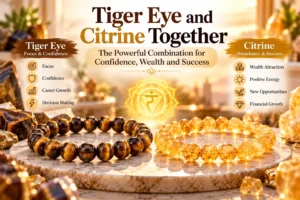
One of the most persistent and consequential confusions in the Indian gemstone market is the substitution of Tiger Eye (Vyaghra Mani) for Lehsunia. Tiger Eye does display a chatoyancy-like shimmer, and it is significantly less expensive than genuine Chrysoberyl Cat’s Eye. But Tiger Eye is a completely different mineral (quartz-based), carries the energy of Surya (Sun) and Mangal (Mars), and has no astrological relationship with Ketu whatsoever.
Wearing Tiger Eye as a Ketu remedy does not strengthen Ketu’s energy; it strengthens Surya and Mangal energy. For someone prescribed Lehsunia for Ketu Mahadasha support or Ketu-related protective purposes, Tiger Eye provides zero benefit in that specific context. It is a different stone serving a different planetary purpose, and the two should never be confused regardless of their visual similarity in certain lights.
Quartz Cat’s Eye is another stone frequently sold as a Lehsunia substitute. Quartz Cat’s Eye is also a valid crystal with its own gentle energetic quality, but it is not an effective substitute for astrological Lehsunia purposes either. The planetary energy of genuine Chrysoberyl Cat’s Eye is not replicable by a lower-hardness quartz mineral with a superficially similar appearance.
Frequently Asked Questions
Is Lehsunia safe to wear without a Jyotishi consultation?
Among all Nav Ratan gemstones, Lehsunia requires Jyotishi consultation most urgently. Ketu’s energy is fast-acting, unpredictable, and deeply chart-specific. The same Ketu placement that makes Lehsunia powerfully protective for one person can make it actively destabilising for another. This is not theoretical caution; experienced Jyotishis consistently advise Lehsunia as the Nav Ratan where self-prescription carries the highest risk of unintended effects. Use the free Janmpatri consultation at Sawariya Gems as a starting point before any Lehsunia purchase.
What is the difference between Lehsunia and Tiger Eye?
Lehsunia (Chrysoberyl Cat’s Eye / Vaidurya) is Ketu’s Nav Ratan gemstone. It is a beryllium aluminium oxide mineral of hardness 8.5 on the Mohs scale, formed under high-temperature geological conditions, and its chatoyancy arises from parallel fibres within the crystal structure. Tiger Eye (Vyaghra Mani) is a quartz-based mineral of hardness 7 whose shimmering quality arises from fibrous crocidolite inclusions. Tiger Eye carries Surya and Mangal energy. It is not a Ketu stone, not a Lehsunia substitute, and not appropriate for any Ketu remedy purpose. The two stones look superficially similar in certain lights but are mineralogically, energetically, and astrologically entirely different.
How long does Ketu Mahadasha last and how does Lehsunia help?
Ketu Mahadasha lasts 7 years in the Vimshottari Dasha system. It typically produces a period of significant internal transformation, often through external disruption, sudden changes, and the dissolution of structures and attachments the person has been holding. Lehsunia helps by strengthening Ketu’s protective and spiritually illuminating qualities while providing a stabilising energetic field against the planet’s more destabilising expressions. The goal of Lehsunia during Ketu Mahadasha is not to eliminate Ketu’s transformative work, which is genuinely valuable even when uncomfortable, but to ensure the person navigating it has the energetic protection and inner stability to receive the transformation constructively rather than being overwhelmed by it.
Which finger should Lehsunia be worn on?
The middle finger (Madhyama) of the right hand in a silver or Panchdhatu setting is the most common prescription. Ketu does not have a dedicated finger in the way that Surya (ring finger) or Chandra (little finger) do in classical Jyotish palmistry, so the middle finger, which carries Shani’s compatible planetary current, is the most widely used option. Some Jyotishis prescribe the ring finger based on specific chart configurations. Confirm the finger with your Jyotishi for your specific chart.
Can Lehsunia be worn for protection from evil eye and black magic?
Yes, and this is one of the most consistent traditional uses of Lehsunia across Indian gemological culture. Ketu governs hidden and occult forces, psychic influences, and the subtle energy dimensions that the term “evil eye” (Nazar) refers to in Indian tradition. A correctly worn and activated Lehsunia provides energetic protection specifically in this domain. The stone’s “eye” appearance carries deep symbolic protection energy, and its Ketu alignment makes it effective against precisely the kind of hidden, indirect, and psychically transmitted negative influences that Nazar and similar phenomena represent. For general Nazar protection without formal gem prescription, a Black Hakik (Black Agate) or Turquoise bracelet also provides accessible protection energy. [Verify before publishing: link to relevant product pages]
For a personalised Lehsunia prescription based on your Ketu placement, current Mahadasha, and specific Lagna, use the free Janmpatri consultation at Sawariya Gems before purchasing any Ketu gemstone.
This guide is for educational purposes based on Vedic Jyotish tradition. Nav Ratan gemstone prescription should always be confirmed by a qualified Jyotishi based on individual birth chart analysis.