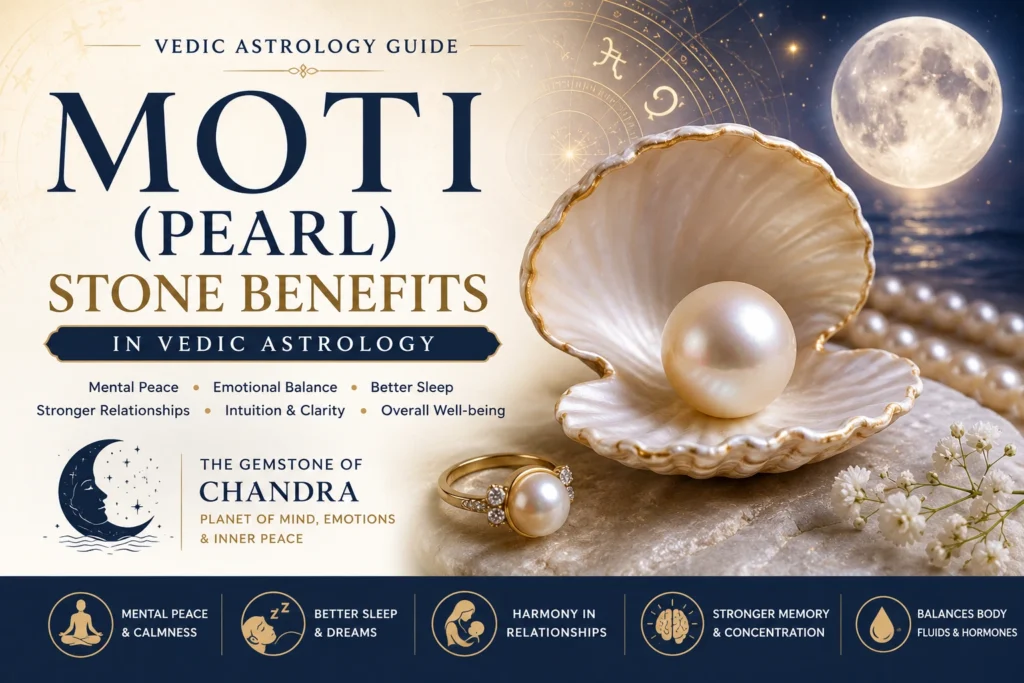
Moti (Pearl) is unlike any other stone in the Nav Ratan system. Every other sacred gemstone forms inside the earth over millions of years. Pearl forms inside a living creature, in water, through a process of quiet, patient layering over time. That origin is not incidental. It perfectly mirrors the energy of the planet it serves, Chandra (the Moon), the planet of the mind, emotions, the mother, and the nourishing, cyclical quality of water. A gemstone born from life and water, worn to heal the inner emotional life: that is Moti.
In Vedic Jyotish, Moti is Chandra’s primary Nav Ratan gemstone. It strengthens the Moon’s position in the birth chart, supporting the mental peace, emotional stability, and intuitive clarity that a well-placed Chandra provides. When the Moon is weak, afflicted, or under planetary pressure, the effects show in the mind first: anxiety, disturbed sleep, emotional volatility, and difficulty concentrating. This is precisely where Moti works.
What Chandra Governs in Vedic Astrology
Understanding Moti’s benefits requires understanding what Chandra (the Moon) actually rules in a Vedic birth chart. Chandra governs the Manas, the Sanskrit term for the emotional, receptive, feeling mind as distinct from the rational intellect. It rules emotional wellbeing, mental peace, intuition, memory, the mother and maternal relationships, the home, all water-related matters in the body (kidneys, lymphatic system, hormonal cycles), sleep quality, and the capacity for deep, nurturing relationships.
A strong Chandra in the birth chart produces emotional stability, a peaceful mind, good memory, a loving relationship with the mother, a secure and comfortable home life, and an intuitive intelligence that reads situations with remarkable accuracy. A weak or afflicted Chandra produces the opposite across all of these areas simultaneously, which is why a poorly placed Moon can affect so many different areas of life at once; they are all governed by the same planet.
Moti’s job is to strengthen that Moon, restore its positive qualities, and protect the Chandra function from the planetary pressures of an afflicted or poorly placed Sun.
Moti Stone Benefits in Vedic Astrology
Mental peace and emotional stability are the most immediate and widely reported benefits of wearing Moti. For people who experience chronic mental restlessness, emotional volatility that seems disproportionate to external circumstances, or the cycle of anxiety and overthinking that a weak Moon produces, Moti provides a measurable calming of the inner emotional field. This is not sedation; it is the specific quality of a strengthened Chandra, the ability to feel emotions fully without being overwhelmed by them.
Sleep quality improves significantly for many Moti wearers. Chandra governs the sleeping mind and the quality of rest and dreaming. Disturbed sleep, vivid unsettling dreams, difficulty falling asleep despite physical tiredness, and the exhausted-but-wired feeling that many Moon-afflicted people recognise; all of these respond to Moti’s Chandra-strengthening effect over consistent wearing.
Memory and concentration fall within Chandra’s domain in Vedic cognitive understanding. Students, professionals in memory-intensive fields, and older individuals experiencing memory decline associated with a weakening Moon often find Moti particularly beneficial. The Manas that Chandra governs is the mind’s receptive, storing function, and strengthening it improves the quality of what goes in and how easily it can be retrieved.
Relationship with the mother and maternal figures is one of the traditional Moti benefits that remains highly relevant. Chandra rules the mother in Vedic tradition, and strained or complicated maternal relationships often correlate with a difficult Chandra placement. Moti supports healing in this area, which can manifest as improved communication, greater emotional closeness, or the resolution of long-standing tensions.
Intuition and psychic sensitivity are heightened by a strong Chandra, and Moti amplifies this quality for those in whom it is already present. Chandra’s intelligence is not the analytical intelligence of Mercury; it is the felt sense of knowing that operates below the level of conscious reasoning. Moti sharpens this capacity, which is why it has traditionally been recommended for healers, counsellors, and those in caring professions where reading others’ emotional states is part of the work.
Physical health areas governed by Chandra, specifically the fluids of the body, the lymphatic system, the kidneys, and hormonal balance, respond to consistent Moti wearing over time. In Ayurvedic Jyotish, Chandra governs all of the body’s water-related functions, and strengthening the Moon through its gemstone supports these systems. Women experiencing hormonally driven emotional patterns specifically may find Moti particularly relevant, as Chandra’s cyclical nature mirrors the hormonal cycle directly.
Who Should Wear Moti
Moti is most clearly indicated for people with Karka (Cancer) Lagna, where Chandra is the Ascendant lord and the most important planet in the entire chart. For Karka Lagna, wearing Moti is almost universally recommended by Jyotishis regardless of other chart factors, as strengthening the Lagna lord strengthens the person’s life force, health, and overall chart function simultaneously.
Vrishabha (Taurus) Lagna is another commonly recommended Lagna for Moti, as Chandra rules the 3rd house of courage, communication, and younger siblings, which is considered a positive house placement. Mithun (Gemini) Lagna benefits from Moti as Chandra rules the 2nd house of wealth, family, and speech; again a broadly positive placement.
Beyond Lagna, Moti is the natural prescription for anyone going through Chandra Mahadasha (the Moon’s 10-year planetary period), particularly in the earlier years of the period when Chandra’s energy most needs support to manifest positively. It is also appropriate for those with Chandra in debilitation (Moon in Vrischika/Scorpio is considered debilitated in Vedic astrology) or those whose Moon is placed in difficult houses and causing the specific mental and emotional difficulties described above.
Moti is also particularly relevant during Sade Sati (the 7.5-year period when Shani transits through the 12th, 1st, and 2nd house from the natal Moon). Sade Sati places Shani’s heavy pressure directly on the Chandra function, producing exactly the mental stress, emotional turbulence, and disrupted home life that Moti is designed to address. For Lagnas where Moti is otherwise appropriate, wearing it during Sade Sati provides the Moon’s own energetic protection during its most pressured transit period.
Who Should Not Wear Moti
Several Lagnas are advised against wearing Moti as a primary gemstone, because for these Ascendants Chandra rules challenging houses in the chart.
Makar (Capricorn) Lagna should generally avoid Moti, as Chandra rules the 7th house of partnerships and marriage for this Ascendant. Over-strengthening the 7th lord can create relationship complications rather than benefits. Kumbha (Aquarius) Lagna is similarly cautious, as Chandra rules the 6th house of illness, debt, and obstacles; strengthening this house through Moti can amplify these areas. Simha (Leo) Lagna requires careful assessment, as Chandra rules the 12th house of loss and foreign travel; Moti may be prescribed in specific circumstances but is not a general recommendation.
Moti should not be worn simultaneously with gemstones for planets that are enemies of Chandra in Vedic astrology. The Moon’s primary enemy is Shani (Saturn), so Moti should never be combined with Neelam (Blue Sapphire). The combination of Chandra and Shani gemstones in the same hand creates a conflicting planetary energy field that typically produces emotional instability rather than the stability Moti is meant to provide.
How to Wear Moti: The Correct Vedic Method
Metal: Silver is Chandra’s own metal and the only appropriate setting for Moti in Vedic tradition. Silver carries the Moon’s cool, receptive, feminine energy and amplifies Moti’s Chandra frequency. Gold is not traditionally used for Moon gemstones as it carries Guru’s (Jupiter’s) solar energy, which is energetically different from Chandra’s lunar quality.
Finger: The little finger (Kanishtha) of the right hand is the most common Jyotish prescription for Moti, as the little finger carries Chandra’s and Budh’s (Mercury’s) energy channels in palmistry tradition. Some Jyotishis prescribe the ring finger as an alternative. Confirm the specific finger with your consulting Jyotishi as preferences vary between schools.
Weight: A minimum of 2 Ratti (approximately 1.8 carats) with 3 to 5 Ratti being the standard prescription for adults. Moti is assessed by weight differently than hard gemstones as its density varies; your Jyotishi will recommend the specific weight appropriate for your chart.
First wearing day: Monday (Somvar) morning during Shukla Paksha (the waxing lunar fortnight) is the ideal first wearing day. The waxing Moon carries increasing Chandra energy, making the activation more potent. Avoid beginning Moti wearing during Krishna Paksha (the waning fortnight).
Activation ritual: On Sunday night, place the Moti ring in a silver or glass bowl with raw milk, Gangajal (Ganga water), and white flowers (jasmine or white rose, both Chandra-aligned). Leave overnight. On Monday morning, remove the ring, rinse with clean water, hold toward the morning sky, and chant the Chandra Beej Mantra Om Shraam Shreem Shraum Sah Chandraya Namah 108 times. Wear immediately on the appropriate finger.
Moti Quality: What to Look For
The Pearl market is one of the most stratified in the gemstone world, with natural Pearls, cultured Pearls, freshwater Pearls, and synthetic imitations all sold under the same name at vastly different prices. For astrological purposes, only natural Pearl carries the full Chandra energy that Vedic Jyotish prescriptions require.
Natural vs cultured: A natural Pearl forms without any human intervention when an irritant enters a mollusc and layers of nacre build up around it over years. A cultured Pearl is produced by deliberately inserting a nucleus bead into a farmed mollusc and harvesting it after a controlled growth period. Cultured Pearls make up nearly all commercial Pearl supply. For astrological wear, natural Pearl is strongly preferred; cultured Pearl is considered a significantly weaker substitute by most Jyotishis.
Basra Pearl (from the Persian Gulf) is the most prized natural Pearl in Vedic gemological tradition and commands extremely high prices due to its rarity; genuine Basra Pearls are now exceptionally rare and require laboratory certification. South Sea Pearls from Australia and the Philippines are the next tier of quality for astrological use. For buyers seeking certified natural Pearl at more accessible price points, freshwater natural Pearls from specific Indian sources are also considered acceptable by many Jyotishis.
Lustre is the most important visual quality indicator. A quality Pearl should have a deep inner glow (not just surface shine) that creates the characteristic “orient” or iridescent depth when turned in light. Dull, chalky, or uniformly shiny Pearls without inner depth are of lower quality and lower astrological potency.
Always request laboratory certification confirming natural (non-cultured) origin from a recognised gemological laboratory before purchasing Moti for astrological wearing. IGI and GIA both certify Pearls, and a reputable seller will have certification available.
Moti Substitutes for Those Who Cannot Access Natural Pearl
Natural Pearl of astrological quality is expensive and genuinely difficult to source with verified certification. Two substitutes carry a portion of Chandra’s energy at accessible price points.
Moonstone (Chandrakant Mani) is the most widely accepted Moti Upratna (Pearl substitute) in Vedic crystal tradition. Its adularescence (the inner floating glow that moves across the surface) directly mirrors the Moon’s light, and it carries Chandra’s emotional calming and intuitive qualities in crystal form. It can be worn in a silver ring on the little finger using the same Monday ritual as Moti for a gentler version of the same Chandra support.
Milky Quartz (Dudhi Sphatik) is a more affordable daily-wear Chandra crystal that can be worn as a bracelet for ongoing Moon energy support without any formal chart prescription. It carries the Crown Chakra calming quality of Chandra’s energy and is safe for all twelve Rashis. Several of Sawariya Gems’ zodiac bracelets include Milky Quartz precisely for this Chandra-calming dimension. [Verify before publishing: link to relevant product pages]
Frequently Asked Questions
Can anyone wear Moti for mental peace?
Moti is relatively gentler in its chart effects than some other Nav Ratan stones, and Karka (Cancer) Lagna wearers in particular can benefit broadly. However, for Lagnas where Chandra rules a difficult house (particularly Makar and Kumbha Lagnas), wearing Moti can amplify the wrong areas of life. For general mental peace without formal chart prescription, Moonstone (Chandrakant Mani) or a Milky Quartz (Dudhi Sphatik) crystal bracelet are safer daily-wear options that carry Chandra’s calming energy without the chart-specific considerations of a Nav Ratan Pearl.
Which finger should Moti be worn on?
The little finger (Kanishtha) of the right hand in a silver setting is the most common Jyotish prescription for Moti. The little finger carries Chandra’s and Budh’s planetary energy channels in Vedic palmistry tradition. Some Jyotishis prescribe the ring finger as an alternative. The specific finger recommendation can vary between Jyotish schools, so confirm with your consulting Jyotishi based on your full chart.
What is the difference between natural Pearl and cultured Pearl for astrology?
A natural Pearl forms entirely without human intervention over several years inside a wild mollusc. A cultured Pearl is farmed with a human-inserted nucleus bead that forms the core, with a thinner layer of natural nacre grown around it in a controlled environment. In Vedic Jyotish, the Chandra energy in a Pearl is understood to be concentrated in the nacre, the layered organic material. Natural Pearls are entirely nacre throughout. Cultured Pearls have a large inert nucleus with a thin nacre layer, making them significantly less astrologically potent by most Jyotish standards. For genuine planetary remedy purposes, only certified natural Pearl is fully effective.
Can Moti be worn during pregnancy?
Moti is traditionally considered one of the most auspicious gemstones during pregnancy, as Chandra governs fertility, the mother, the womb, and the nurturing dimension of new life. For women with appropriate Lagna placements, many Jyotishis specifically recommend Moti during pregnancy for the mental peace, emotional stability, and hormonal balance it supports. That said, any gemstone worn during pregnancy should be confirmed as appropriate by a Jyotishi reviewing the specific chart rather than assumed to be beneficial based on general guidance.
How long does Moti take to show results?
Initial effects such as improved sleep quality, a noticeable calming of the emotional field, and reduced mental restlessness are typically felt within the first two to four weeks of consistent wearing. Deeper chart-level changes, such as improvements in relationships, career recognition in Moon-governed fields, or resolution of maternal relationship patterns, develop over three to six months of uninterrupted wearing. Moti should be worn continuously except during bathing and sleep, and should be kept away from chemicals including perfume, which degrades the Pearl’s organic surface over time.
For a personalised Moti prescription based on your Lagna, Chandra placement, and current Mahadasha, use the free Janmpatri consultation at Sawariya Gems before purchasing.
This guide is for educational purposes based on Vedic Jyotish tradition. Nav Ratan gemstone prescription should always be confirmed by a qualified Jyotishi based on individual birth chart analysis.