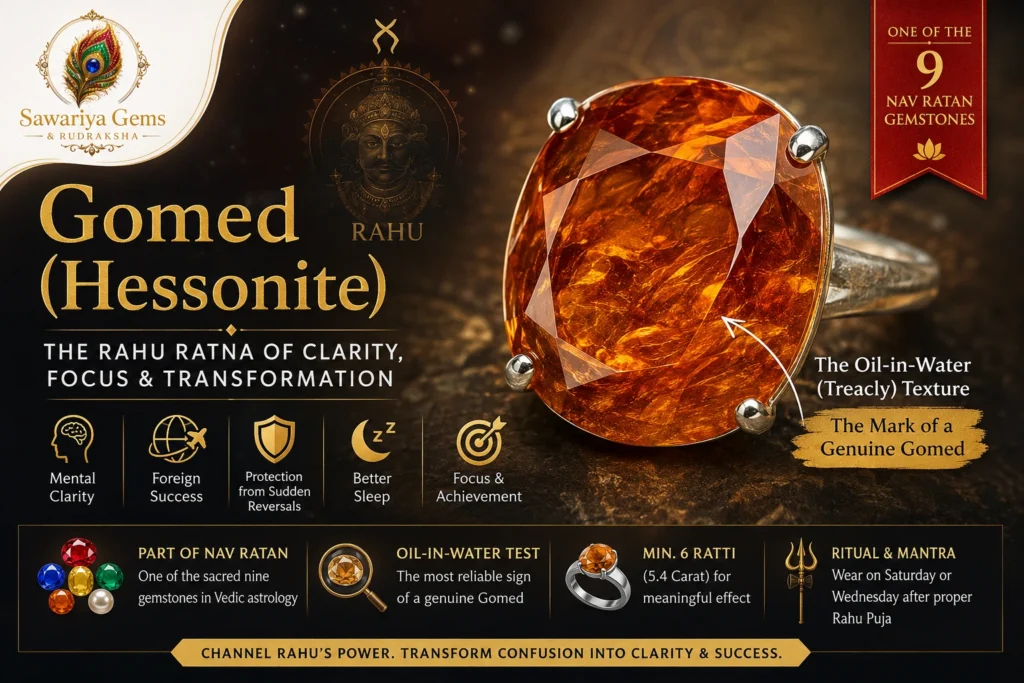
Of all nine Nav Ratan gemstones, Gomed is the one with the most unusual internal appearance — and the one most frequently misunderstood as a result. Genuine Hessonite has a distinctive “oil-in-water” or treacly quality inside the stone that many buyers mistake for a flaw. It is the opposite. It is the single most reliable sign that the stone in front of you is real.
This guide covers what Gomed actually does astrologically, who should wear it, how to perform the oil-in-water test yourself, and why this stone — at one of the most affordable price points among the Nav Ratan — deserves far more attention than it typically gets.
What Is Gomed (Hessonite)?
Gomed Stone — also called Hessonite, Gomedak, or Cinnamon Stone — is the Rahu Ratna in Vedic astrology. Mineralogically, it is a variety of grossular garnet, distinguished by its warm honey-yellow to honey-orange colour and a unique internal texture that no other gemstone in the Nav Ratan family possesses.
Rahu is unlike any other planet in the Vedic system. It has no physical form — it is a mathematical point, the ascending lunar node, a shadow rather than a body. And yet in the birth chart, Rahu represents some of the most defining human experiences: obsessive ambition, the pull toward the foreign and unconventional, sudden reversals of fortune, technology, and the karmic hunger carried forward from previous lifetimes.
Gomed carries this shadow planet’s energy in a form that can be worked with directly — channelling Rahu’s intensity into focus rather than confusion. Not sure if Rahu is significant in your chart right now? Use our free Janmpatri consultation to find out before purchasing.
What Rahu Governs — and What Gomed Addresses
Rahu’s domain in the birth chart includes unfulfilled desires carried from past lives, ambition that exceeds ordinary limits, foreign connections and travel, technology and modern innovation, sudden and unexpected change, and the specific kind of confusion that comes from wanting something intensely without fully understanding why.
When Rahu is afflicted, or when a person enters Rahu Mahadasha — the 18-year period ruled by this shadow planet — the challenging expressions of Rahu’s energy tend to surface. This typically looks like a persistent sense of confusion or illusion, where situations that should be clear remain murky. Sudden setbacks that seem to come from nowhere. Obstacles that appear despite genuine, sustained effort. A restless, circular quality of thinking that does not resolve no matter how much it is examined.
Gomed works by giving Rahu’s intense, scattered energy a more constructive channel. It does not eliminate ambition or shrink desire — it brings clarity to what was confused, and helps the planet’s drive translate into actual, tangible achievement rather than endless striving without arrival.
Gomed Stone Benefits — What It Actually Does
Mental clarity through confusion. This is the most immediately noticed and most consistently reported benefit. Rahu’s characteristic challenge is a fog — an inability to see a situation plainly, to know what the right next step is, or to distinguish what is genuinely important from what only feels urgent. Compatible wearers describe this fog beginning to lift within weeks of consistent wearing. Decisions that had felt impossible start to clarify.
Success in technology, foreign work, and unconventional fields. Rahu governs exactly these domains. People working in technology, exports and imports, media, foreign trade, or any field that crosses conventional boundaries often report improved flow and fewer unexpected obstacles when wearing Gomed during Rahu Mahadasha or during periods of strong Rahu influence.
Protection from sudden reversals. Rahu is associated with abrupt, unpredictable changes of fortune — both positive and negative. Gomed’s strengthening of constructive Rahu energy tends to soften the destabilising quality of sudden negative reversals and, for some wearers, increases the likelihood of positive sudden opportunities arriving from unexpected directions.
Improved sleep. Disturbed, restless, or anxious sleep is a classic symptom of an afflicted Rahu — the planet governs the subconscious mind and dream states. Many Gomed wearers report a noticeable settling of this restless quality, with sleep becoming deeper and less interrupted by anxious or racing thoughts.
Resolution of obsessive thought patterns. Rahu’s energy, when unchecked, can manifest as circular, obsessive thinking — returning again and again to the same worry or desire without resolution. Gomed’s clarifying effect on Rahu often reduces this pattern significantly, creating more mental spaciousness and less compulsive rumination.
The Oil-in-Water Test — How to Identify Genuine Gomed
This is the single most important thing to understand before buying Hessonite, and it is something almost no seller explains clearly.
Genuine Hessonite garnet has a distinctive internal appearance that gemologists call “roiled” or “treacly” — it looks like honey, or like oil swirling slowly through warm water. This is caused by the irregular distribution of calcium and aluminium within the garnet’s crystal structure as it forms in the earth. The uneven mineral distribution creates zones of slightly different refractive indices, and the result is this warm, almost liquid-looking internal quality.
This is not a defect. It is the single most reliable authenticity marker for Hessonite. A stone that is sold as Gomed but is perfectly clear and uniform inside — with no trace of this treacly internal quality — is far more likely to be glass, synthetic material, or a different mineral entirely.
How to perform the test yourself: Hold the loose stone up to a light source — natural daylight works best, or a bright torch. Look into the stone, not just at its surface. A genuine Hessonite stone will show a warm, swirling, honey-like internal texture, almost as though something fluid is suspended inside the solid stone. The effect is subtle but unmistakable once you know what to look for.
Stones with a perfectly transparent, glass-clean interior, or stones with obvious gas bubbles, are not genuine Hessonite regardless of what colour or price they are sold at.
Gomed Quality — Colour, Origin, and Weight
Colour. The finest astrological Gomed has a warm honey-yellow to honey-orange colour — described in traditional Jyotish texts as Gomedak-varna, or “honey colour.” This warm golden tone carries Rahu’s energy most directly. Very pale stones lack the intensity needed for meaningful astrological effect. Very dark, brownish-red stones are considered lower grade for astrological purposes, though they remain genuine garnet.
Origin. Ceylon (Sri Lanka) Hessonite — sometimes traded under the name Cinnamon Stone — produces the finest astrological quality, with the most characteristic warm colour and the clearest expression of the oil-in-water internal texture. African Hessonite, from Tanzania and Mozambique, is also effective for astrological use, though it often runs slightly darker in tone.
Carat weight (Ratti). Gomed requires more weight than most other Nav Ratan gemstones — a minimum of 6 Ratti (approximately 5.4 carats) is necessary for meaningful astrological effect. This is because Rahu is considered a heavy, dense planetary energy that needs a correspondingly substantial physical presence to channel effectively. For strong Rahu Mahadasha or significant Rahu affliction, 8 to 12 Ratti is the standard recommendation.
Despite this higher minimum weight requirement, Gomed remains the most accessible Nav Ratan by price — a reflection of garnet’s relative abundance compared to corundum (sapphire/ruby) or beryl (emerald) gemstones.
Who Should Wear Gomed
Unlike Nav Ratan stones tied to a specific zodiac sign, Gomed’s suitability depends entirely on Rahu’s house placement and strength in the individual birth chart rather than the Rashi alone. That said, certain situations consistently call for Gomed remedy:
- Anyone in Rahu Mahadasha — the 18-year period, the second-longest of all Mahadashas after Saturn’s 19 years
- People with afflicted Rahu creating confusion, sudden reversals, or persistent obstacles despite genuine effort
- Anyone working in technology, media, film, or foreign trade — domains directly governed by Rahu
- People with significant foreign connections in their work, residence, or relationships
- Anyone experiencing the obsessive, circular thinking characteristic of difficult Rahu periods
- People who have undergone a sudden, inexplicable reversal of fortune or reputation
Because Rahu’s effects are so individually chart-dependent, a Janmpatri reading is more important for Gomed than for some other Nav Ratan stones where Rashi alone gives a clear indication. Our free Janmpatri consultation will assess your specific Rahu placement and current Mahadasha status.
How to Wear Gomed — Complete Ritual
Metal: Silver is most effective for Rahu stones. Panchdhatu is also suitable. Gold is generally avoided for shadow planet remedies.
Finger: The Madhyama — the middle finger — of the right hand. Some Jyotishis recommend the Kanishtha (little finger) for specific chart configurations.
Day and time: Saturday (Shanivar) or Wednesday (Budhvar) at sunrise. Both days are accepted in different traditions — Saturday connects to Rahu’s deep karmic, shadow quality, while Wednesday connects to Mercury’s intelligence, which complements and clarifies Rahu’s ambition.
First wearing ritual:
- Bathe and wear clean clothes
- Purify the ring in Ganga jal and Tulsi leaves
- Sit before a Rahu Yantra or an image of Bhairav — Rahu has a traditional association with Bhairav in Vedic worship
- Chant Om Raam Rahave Namah or Om Bhraam Bhreem Bhraum Sah Rahave Namah — 108 times
- Wear the ring on the Madhyama of the right hand
Offering coconut, sesame sweets (til ke ladoo), and blue flowers is the traditional accompaniment to Rahu Puja, and is considered to strengthen the effectiveness of wearing Gomed.
Gomed and Ketu — Why These Two Are Often Considered Together
Rahu and Ketu are always exactly opposite each other in the birth chart — wherever Rahu sits, Ketu sits in the directly opposing house, 180 degrees away. This is a mathematical certainty of how the lunar nodes work, and it means that anyone whose chart shows significant Rahu influence will, by definition, also have a corresponding Ketu placement worth examining.
For this reason, many Jyotishis recommend assessing both nodes together rather than addressing Rahu in isolation. If your Rahu placement is significant enough to warrant a Gomed remedy, it is worth checking whether your Ketu placement also calls for attention — and whether Cat’s Eye (Lehsunia), Ketu’s corresponding gemstone, should be considered alongside it.
This dual-node approach is not mandatory for everyone, but it is the more complete picture for anyone undergoing a serious assessment of either Rahu or Ketu’s role in their chart.
Frequently Asked Questions
What is the oil-in-water texture inside Gomed, and is it normal?
Yes — it is not only normal, it is the most reliable sign that the stone is genuine. The oil-in-water or treacly appearance is caused by the natural, irregular distribution of calcium and aluminium within the garnet crystal as it forms. This effect cannot be reliably replicated in glass or most synthetic materials, which is why its presence is considered a positive authenticity marker rather than a flaw.
How many Ratti of Gomed should I wear?
A minimum of 6 Ratti (approximately 5.4 carats) — significantly more than the 2 to 3 Ratti minimum for some other Nav Ratan stones. This is because Rahu is considered a heavy planetary energy that requires a correspondingly substantial physical presence in the stone. For Rahu Mahadasha specifically, 8 to 12 Ratti is the standard recommendation.
Can Gomed be worn without checking my birth chart?
It is not recommended. Unlike Pukhraj, which is broadly safe for most charts, Gomed’s suitability depends heavily on the individual placement and strength of Rahu in your specific birth chart rather than your Rashi alone. A Janmpatri reading gives a far more reliable answer than guessing based on general symptoms.
What is the difference between Gomed and other garnets?
Gomed specifically refers to Hessonite — a variety of grossular garnet with a honey-yellow to honey-orange colour and the characteristic oil-in-water internal texture. Other garnet varieties, such as Almandine (deep red) or Tsavorite (green), are mineralogically related but are not used as the Rahu Ratna in Vedic astrology. Always confirm “Hessonite” or “grossular garnet” specifically on the laboratory certificate.
Why is Gomed cheaper than other Nav Ratan stones?
Garnet, including Hessonite, is significantly more abundant in nature than corundum (used for ruby and sapphire) or beryl (used for emerald). This natural abundance is reflected in the price — Gomed remains effective and genuinely potent for Rahu remedy at a fraction of the cost of stones like Neelam or Pukhraj stone , making it one of the most accessible entry points into Nav Ratan gemstone therapy.