
Most people who buy Rudraksha get the bead right and the ritual wrong. They wear it the same day it arrives, on whichever finger feels convenient, with no mantra and no purification — and then wonder months later why nothing seems to have shifted. The bead itself does only part of the work. The way it is worn for the first time, and the consistency with which it is worn afterward, does the rest.
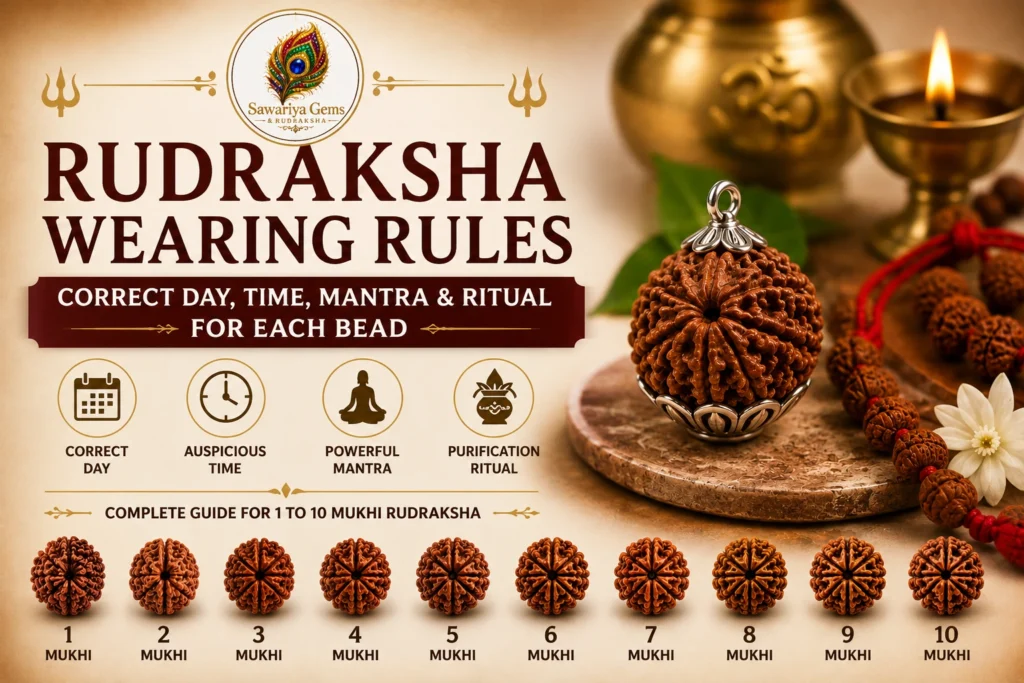
Rudraksha Wearing Rules guide covers the correct day, time, mantra, and ritual for each of the 10 Mukhi Rudraksha — along with the broader rules around lunar phases, purification, and metal that apply across all of them.
Shukla Paksha — Why Timing Matters Before You Even Touch the Bead
Shukla Paksha is the waxing phase of the Moon — the roughly two-week period between Amavasya (new moon) and Purnima (full moon) when the Moon is growing fuller each night. In Vedic tradition, this is considered the building, expansive half of the lunar cycle, and it is the preferred window for beginning any new spiritual practice, including first wearing a Rudraksha.
The logic is straightforward: Krishna Paksha — the waning half of the cycle — is associated with release, withdrawal, and diminishing energy. Starting something new during this phase is traditionally avoided because the lunar energy is working against growth rather than with it. Shukla Paksha, by contrast, supports new beginnings precisely because the Moon’s own energy is expanding alongside whatever intention you are setting.
This rule applies to all 10 Mukhi Rudraksha without exception. Before you finalise a first-wearing date for any bead below, check that it falls within Shukla Paksha. If you are unsure how to calculate this for your location, any Hindu Panchang (almanac) app or website will show the current lunar phase clearly.
Pushya Nakshatra — The Exception Worth Knowing
While Shukla Paksha governs the lunar phase, Nakshatra governs the specific star constellation the Moon is passing through on any given day — a finer layer of timing that some Rudraksha and gemstone traditions consider especially important for certain beads.
Pushya Nakshatra is widely regarded as one of the most auspicious Nakshatras in the entire lunar calendar — its name literally relates to nourishment and flourishing. For Rudraksha beads connected to Saturn — most notably the 7 Mukhi — and for gemstones like Neelam (Blue Sapphire), a first wearing that falls on a day when Pushya Nakshatra coincides with the correct day of the week (Saturday for Saturn-related items) is considered exceptionally powerful.
This is not a requirement for every bead, but it is worth checking specifically if you are wearing the 7 Mukhi Rudraksha or planning to wear Neelam. A Panchang will show you the next few dates when Pushya Nakshatra falls on a Saturday — these are the windows to prioritise if your schedule allows flexibility.
The Purification Ritual — Common to All Rudraksha
Before any Rudraksha is worn for the first time, it should be purified. This single step is skipped more often than any other part of the ritual, and it matters more than people assume — the purification is what formally prepares the bead to carry the intention you are about to set.
Standard purification method:
- Soak the Rudraksha in clean Ganga jal (Ganges water, available from most puja stores or temples) for at least 20 to 30 minutes
- If available, a small amount of Panchgavya — the traditional five-product mixture from cow (milk, curd, ghee, urine, and dung, used in a highly diluted ritual form) — can be added to the purification water for an even more traditional approach. This is optional and many households today purify with Ganga jal and raw milk alone
- Pat the bead dry gently with a clean cloth — do not use synthetic or chemical-treated cloth
- Hold the bead in your right palm and chant the relevant Mukhi’s mantra (listed below) before threading it onto its cord or stringing it for wear
This purification should be repeated whenever the Rudraksha has been removed for an extended period, dropped on the ground, or handled by someone outside your household before you received it.
Which Metal for Which Bead — General Rule
Unlike Nav Ratan gemstones, where the wearing metal (gold, silver, Panchdhatu) is strictly matched to the ruling planet, Rudraksha is traditionally worn on a simple red or black thread (lal dora or kala dora) rather than set in metal — particularly for single beads worn as pendants or on a wrist mala.
When a metal cap or setting is used — common for pendant-style Rudraksha — the same planetary logic that governs gemstones applies loosely: gold for Sun, Jupiter, and Mars-associated beads (1, 3, 5, 12 Mukhi); silver for Moon and Venus-associated beads (2, 6 Mukhi); and Panchdhatu as a safe universal option for Saturn, Rahu, and Ketu-associated beads (7, 8, 9 Mukhi) where gold is traditionally avoided.
If in doubt, a plain red thread is always traditionally correct for any Mukhi and is, in fact, the more ancient and widely practised method compared to metal settings.
Day, Time and Mantra for Each Mukhi Rudraksha
Below is the correct wearing protocol for each of the 10 Mukhi beads. The structure is consistent: which planet and deity the bead is associated with, the best day to first wear it, and the mantra to chant during the purification and first-wearing ritual.
1 Mukhi Rudraksha — Sun, Lord Shiva (Sadashiva)
Day: Sunday (Ravivar) at sunrise. Mantra: Om Hreem Namah — 108 times. Note: The rarest and most expensive Mukhi; particularly suited for those seeking clarity of purpose and spiritual authority.
2 Mukhi Rudraksha — Moon, Ardhanarishvara
Day: Monday (Somvar) at sunrise. Mantra: Om Namah — 108 times. Note: Often worn by couples together to strengthen unity; first wearing on Purnima is considered especially favourable.
3 Mukhi Rudraksha — Mars, Agni
Day: Tuesday (Mangalvar) at sunrise. Mantra: Om Kleem Namah — 108 times. Note: Commonly worn alongside Moonga (Red Coral) for Mangal Dosha remedy; the fire deity association makes it suited for releasing guilt and past regret.
4 Mukhi Rudraksha — Mercury, Brahma
Day: Wednesday (Budhvar) at sunrise. Mantra: Om Hreem Namah — 108 times. Note: Favoured by students and anyone in communication-heavy professions; pairs naturally with Panna (Emerald).
5 Mukhi Rudraksha — Jupiter, Kalagni Rudra
Day: Thursday (Guruvar) at sunrise. Mantra: Om Hreem Namah — 108 times. Note: The most commonly worn Rudraksha worldwide; suitable for almost everyone with no significant contraindications, much like Pukhraj among the Nav Ratan.
6 Mukhi Rudraksha — Venus and Mars combined, Kartikeya
Day: Friday (Shukravar) at sunrise. Mantra: Om Hreem Hum Namah — 108 times. Note: Often recommended alongside the 3 Mukhi for those needing both Mangal Dosha support and relationship harmony.
7 Mukhi Rudraksha — Saturn, Mahalakshmi
Day: Saturday (Shanivar) at sunrise — ideally during Pushya Nakshatra. Mantra: Om Hum Namah — 108 times. Note: The primary Rudraksha remedy for Sade Sati; check our complete Sade Sati guide if you are wearing this for Saturn-related reasons.
8 Mukhi Rudraksha — Rahu, Lord Ganesha
Day: Saturday or Wednesday at sunrise. Mantra: Om Hum Namah — 108 times. Note: Associated with obstacle removal and new ventures; commonly worn by entrepreneurs and those starting new business ventures.
9 Mukhi Rudraksha — Ketu, Goddess Durga
Day: Tuesday or Thursday at sunrise; first wearing during Navratri is considered especially auspicious. Mantra: Om Hreem Hum Namah — 108 times. Note: Worn for spiritual protection and during Ketu Mahadasha.
10 Mukhi Rudraksha — All nine planets, Lord Vishnu
Day: Any day, though Thursday is preferred for its Vishnu association. Mantra: Om Hreem Namah Namah — 108 times. Note: Often gifted rather than worn for a single planetary reason, since it is associated with all nine planets simultaneously; a strong general protection bead.
The First Wearing Ritual — Step by Step
Once you have selected the correct day for your specific Mukhi and completed the purification described above, the first wearing follows a consistent sequence across all 10 beads:
- Bathe before sunrise or shortly after, on the chosen day
- Complete the Ganga jal purification described earlier
- Sit facing east, in a quiet space, ideally before a small puja area or image of the associated deity
- Hold the Rudraksha in your right palm and chant the relevant mantra 108 times (a minimum of 11 times if 108 is not practical on the first attempt)
- Set a clear, specific intention for why you are wearing this particular bead
- Wear the Rudraksha around your neck, on your wrist, or as instructed for that specific bead — most Mukhi beads are worn as a pendant on a red or black thread close to the chest
After this first wearing, the Rudraksha should ideally not be removed except for bathing, sleeping, or specific situations requiring its temporary removal (such as visiting a crematorium, which is traditionally discouraged while wearing Rudraksha).
Common Mistakes to Avoid
Wearing a Rudraksha that has not been purified is the most common error — buyers frequently put the bead on the same day it arrives, straight out of its packaging, without any ritual at all. This does not make the bead ineffective, but it skips the formal step of preparing it to carry intention.
Wearing multiple Mukhi beads without understanding their combined effect is another frequent mistake. Some combinations — like 1 and 5 Mukhi, or 7 and 8 Mukhi — are traditionally considered complementary and powerful together. Others are simply worn together without any particular planetary logic, which dilutes the focus each individual bead is meant to bring.
Removing and re-wearing a Rudraksha frequently, or letting it pass through many hands, is also discouraged. The bead is meant to build a consistent, undisturbed relationship with the wearer over time — frequent removal and handling by others interrupts this.
Frequently Asked Questions
What happens if I wear my Rudraksha on the wrong day?
It is not a catastrophic error — Rudraksha is generally considered more forgiving than gemstones like Neelam in terms of timing precision. However, choosing the correct day and lunar phase for first wearing is still recommended because it aligns the beginning of your practice with supportive energy rather than working against it. If you have already worn your Rudraksha on an unplanned day, you can still complete a proper purification and mantra ritual at the next opportunity to formally reset the intention.
Can I wear more than one Mukhi Rudraksha at the same time?
Yes, and many people do. Certain combinations are traditionally considered especially powerful together — 1 and 5 Mukhi for general spiritual clarity, 7 and 8 Mukhi for Saturn and Rahu support, 5 and 9 Mukhi for students seeking both wisdom and protection. The key is understanding which planetary energies you are combining rather than wearing multiple beads without a clear reason.
Do I need a priest to perform the wearing ritual?
No. The ritual described in this guide can be performed independently at home. A priest or Jyotishi can add depth and personalised guidance, particularly if you are uncertain which Mukhi is right for your chart, but the purification and mantra ritual itself does not require third-party officiation.
What if I cannot find a day that matches both Shukla Paksha and the correct day of the week?
Prioritise Shukla Paksha first — the lunar phase is considered the more important of the two conditions. Within Shukla Paksha, choose the closest available occurrence of the correct day of the week (Sunday for 1 Mukhi, Thursday for 5 Mukhi, and so on). The two conditions align naturally several times during each lunar month, so a suitable date is rarely more than two or three weeks away.
Should I remove my Rudraksha for menstruation, illness, or specific events?
Practices vary by tradition and personal belief. Many wearers keep their Rudraksha on continuously regardless of these situations, while some traditions recommend temporary removal during specific circumstances such as visiting a crematorium or during periods of mourning. There is no single universally agreed rule here — follow what feels appropriate within your own family or community’s practice, and consult a Jyotishi if you want a more definitive answer specific to your situation.