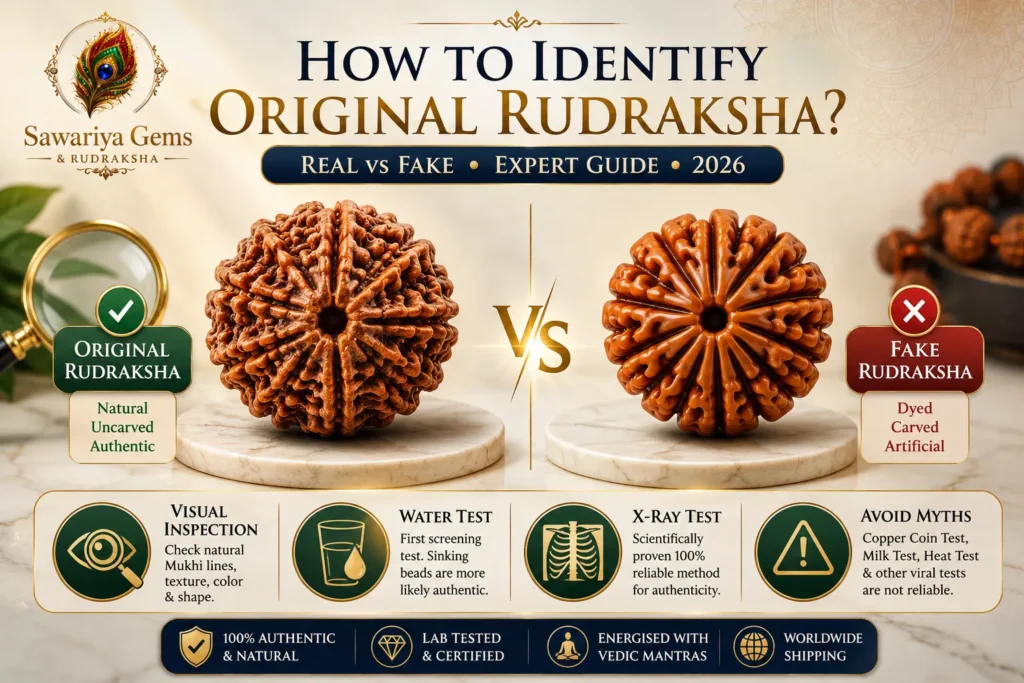
At least 30 percent of the Rudraksha beads circulating in the Indian market are fake. This number comes from surveys of Rudraksha traders and is cited consistently across the industry. It means that if you walk into a random shop or order from an unknown online seller, the probability that what you receive is not genuine Rudraksha is one in three.
The problem is not just financial. A person wearing a Rudraksha for a specific planetary remedy or spiritual practice is doing so because they believe the bead’s energy is working with their own. A fake bead : plastic, resin, a different seed carved to look like Rudraksha : carries none of that energy. The years of wearing an inauthentic bead are years of genuine practice built on a false foundation.
This guide covers exactly what you need to know: what genuine Rudraksha looks like,identify original Rudraksha, which home tests give real information, which widely-shared tests are myths, the one test that is scientifically conclusive, and how to evaluate a seller before purchasing. We will also be honest about what the tests can and cannot tell you.
What Genuine Rudraksha Actually Looks Like : Visual Identification First
Before any test, the most important skill is knowing what a genuine Rudraksha bead looks like through direct observation. An original Rudraksha is very easily identified by an experienced eye. Most experienced buyers can assess authenticity from visual inspection alone. Building this visual literacy is the most practical long-term skill for anyone who buys Rudraksha regularly.
Surface texture: The authentic bead will have a rough and uneven surface. A fake bead’s surface will feel too smooth, glossy, or like plastic. If that is so, it is a red flag. Genuine Rudraksha is never perfectly smooth. It has a naturally rough, organic texture with slight variations across its surface. A bead that feels like polished wood or plastic is suspect.
Shape and symmetry: Real Rudraksha beads are rarely perfectly round. They are naturally asymmetrical. Machine-made fakes and moulded plastic beads tend to be uniformly round. Genuine Rudraksha has natural asymmetry : it is approximately round but with the organic irregularity of a seed rather than a manufactured sphere.
Mukhi lines: A real Rudraksha has natural, clear, and unbroken Mukhis, with no artificial cuts or lines. The Mukhi lines are the most critical visual indicator. On genuine Rudraksha, these lines run continuously from the top cap (where the bead attaches to a string) to the bottom cap. They have a natural, slightly irregular quality : not perfectly uniform in width or perfectly parallel. Artificially carved lines on fakes look too uniform, too deep, or too symmetrical.
Colour: The natural colour of Rudraksha beads varies from light brown to deep reddish-brown. If it looks bright red, shiny black, or artificially coloured, it is likely dyed. Genuine Rudraksha has a warm brown to dark reddish-brown tone that is organic and slightly varied across the surface. Unnaturally uniform colour, bright red, or shiny black colouring indicates dyeing or artificial treatment.
The drill hole: Authentic Rudraksha beads naturally have a hole running through the centre for stringing. The hole should look natural and slightly uneven. If the hole looks too perfectly drilled or artificially made, it may indicate a fake bead. The natural hole in a real Rudraksha will not be perfectly round or too wide.
Nepal vs Java Rudraksha differences: Nepali Rudraksha is darker and bigger in size, featuring deeper grooves. Javan (Indonesian) Rudraksha is smaller and has finer, more delicate lines. However, all authentic Rudraksha feel solid, like dry wood, but not too heavy. Both origins are genuine; they look different from each other but are both authentic Elaeocarpus ganitrus seeds.
Home Tests That Work : Honest Assessment
The internet is full of Rudraksha authenticity tests, many of which are repeated so widely that they are now treated as established fact. The honest truth is that most home tests give partial information at best and can be actively misleading at worst. Here is a clear-eyed assessment of each.
Test 1 : Water Float Test
Drop the bead in a glass of clean water. If it sinks, it is likely an original Rudraksha. If it floats, it may be fake.
Does it work? Partially. It reliably identifies plastic and hollow wood fakes : these float clearly. However: A real Rudraksha can float if it is too dry or light. Similarly, a fake one can sink if it is filled or coated with heavy glue. This means a positive result (sinking) gives partial reassurance but not confirmation. A negative result (floating) on a dry bead does not definitively indicate a fake.
Use it as: A first screening test. Floating beads warrant closer inspection. Sinking beads still need visual inspection and ideally X-ray confirmation for high-value beads.
Test 2 : Mukhi Line Needle Test
Use a sharp needle to gently poke along Mukhi lines. If the needle sticks in the line and can be inserted into it, the line indicates a hidden seam : a sign the bead may be joined from multiple pieces disguised as Mukhi lines. Authentic Rudraksha lines are natural grooves, not seams.
Does it work? Yes : this is one of the more reliable home tests for detecting joined fakes (beads made from two or more pieces of wood or seed glued together with the joins disguised as Mukhi lines). The needle entering a line deeply indicates a seam. Natural Mukhi lines do not allow needle penetration.
Use it as: A reliable detection method specifically for joined/glued fakes. Does not detect correctly-shaped plastic or resin fakes.
Test 3 : Visual Magnification Test
Use a magnifying glass to check Mukhi lines : they should be natural and continuous. Artificial lines appear too uniform, too deep, or show tool marks under magnification.
Does it work? Yes : this is the most informative home test available to buyers with no laboratory access. Under a 10x loupe or even a good smartphone camera in macro mode, the difference between naturally formed Mukhi lines and artificially carved ones becomes visible. Natural lines have organic variation; carved lines have consistent tool-mark regularity.
Use it as: The primary visual assessment tool. Combine with the needle test for carved fakes. A 10x loupe costs less than ₹300 and is a worthwhile investment for anyone who buys Rudraksha regularly.
Test 4 : Weight and Density Test
Rudraksha beads are relatively heavy compared to wooden imitations. If a bead feels very light for its size, it may be a fake. Real Rudraksha has a solid, earthy weight.
Does it work? Partially. It reliably identifies hollow or very light fakes. However, well-made resin fakes and lead-filled hollow fakes can mimic the correct weight. Useful as part of an overall assessment but not conclusive alone.
Use it as: A supporting test. Combine with visual inspection and needle test.
Test 5 : Surface Rub Test
Rub the bead gently. Authentic beads will not peel or leave colour stains on your fingers or on a damp white cloth.
Does it work? Yes : for detecting dyed or painted fakes. Genuine Rudraksha’s colour is from the natural seed; rubbing with a damp cloth leaves no colour transfer. A dyed fake will leave colour residue.
Use it as: A quick check for dyed imitations. One of the simpler and more reliable home tests.
Home Tests That Are Myths : Be Honest With Yourself
These tests are widely shared across YouTube, WhatsApp, and spiritual websites. They feel satisfying to perform. They produce visible results that seem meaningful. But the honest assessment from Rudraksha experts, gemologists, and the research that has been done on these tests is consistent: they are not reliable indicators of authenticity.
The Copper Coin Test
The Copper Coin Test suggests that a Rudraksha bead will rotate between two copper coins if it is genuine. However, this has no scientific basis and is not a reliable method of identification. Even a manipulated Rudraksha (where extra Mukhi lines are carved) can pass this test, because it is still originally a Rudraksha bead. This makes the test misleading, as it cannot distinguish between natural and altered beads.
That rotation happens due to shape and texture, not energy. It is a complete myth. Do not rely on it.
The Milk Test
Many sellers claim that placing Rudraksha in milk overnight will cause the milk to sour or turn blue if the bead is genuine. This test is misleading. Authenticity cannot be judged by milk. The milk simply acts as a soaking medium : the same as water. Any organic material placed in milk overnight at room temperature will affect the milk through natural bacterial interaction. This test has no scientific basis for identifying Rudraksha.
The Boiling Test
Boiling a Rudraksha bead in water to check if it breaks or shows glue is sometimes recommended for identifying joined fakes. It can reveal fake glued beads, but it also damages real ones. Avoid it unless you are ready to ruin your bead. Heat and prolonged water immersion damage natural Rudraksha. This test is destructive and unreliable.
The Only 100% Reliable Test : X-Ray
The X-Ray test is the only conclusive scientific method to assess the internal structure of a Rudraksha bead and determine whether it is original, fake, or manipulated.
Here is how it works: A genuine Rudraksha will always have the same number of internal compartments as the number of Mukhi lines visible on its surface, with each compartment ideally containing a seed. If an X-Ray shows fewer chambers than visible lines, it is a carved fake.
The logic is simple and impossible to deceive: you can carve extra lines on the surface of a Rudraksha, and you can mould a plastic bead to have the right number of lines, but you cannot fake the internal seed chambers. An X-Ray shows the internal structure directly. Genuine Rudraksha has one chamber per Mukhi line. A 5 Mukhi shows 5 chambers; a 7 Mukhi shows 7 chambers. Any mismatch between the visible Mukhi count and the internal chamber count confirms manipulation.
However, X-Ray alone does not prove authenticity. True authentication combines careful external examination (natural Mukhi lines, surface integrity, formation) with detailed analysis of the internal structure through X-Ray. Only when both aspects are studied together can an expert accurately determine whether a Rudraksha is genuine, manipulated, or fake.
Who should get an X-Ray test: For 5 Mukhi Rudraksha used as a mala in high quantity, the visual tests above provide sufficient confidence when combined. For rare and high-value beads : 1 Mukhi, 2 Mukhi Nepal, 11 Mukhi, 14 Mukhi, 15 Mukhi and above : X-Ray testing from a certified Rudraksha lab is strongly recommended before purchase. The cost of lab testing is justified by the cost of the bead.
Common Types of Fake Rudraksha in the Market
Knowing what the most common fakes look like helps you identify them faster. These are the specific types most frequently encountered:
Plastic moulded fakes: The most common low-cost fake. Uniformly round, perfectly smooth, artificially uniform in colour. These are caught immediately by the visual inspection and the water test (most float). They pass the copper coin test, which is why that test is meaningless.
Carved wood fakes: A seed or bead of different wood (often Betel nut, Mango seed, or other tropical tree seeds) shaped and carved to mimic Rudraksha. These are heavier and more convincing than plastic but show inconsistent grain under magnification. The Mukhi lines look carved rather than grown. The needle test often catches these.
Joined fakes: Two or more pieces of genuine or non-genuine material joined with glue, with the seam disguised as a Mukhi line. These specifically target buyers looking for high-Mukhi rare beads at low prices. A 14 Mukhi bead made from two 7 Mukhi beads joined is the classic version. The needle test catches these reliably when performed carefully along every Mukhi line.
Carved genuine Rudraksha (manipulated beads): The most sophisticated fake : a genuine Rudraksha bead with extra Mukhi lines artificially carved onto its surface to increase its Mukhi count and therefore its value. A 5 Mukhi carved to appear as an 8 Mukhi. These pass visual inspection by casual observers, pass the water test, and even pass the copper coin test because the base material is genuine Rudraksha. Only X-Ray testing reveals the mismatch between the carved surface lines and the genuine internal chambers.
Dyed genuine Rudraksha: Genuine Rudraksha beads that have been dyed to achieve a more uniform, attractive colour : often a deeper reddish-brown than the natural bead’s actual shade. The dye test (damp white cloth) catches these. The bead is technically genuine Rudraksha but has been treated in a way that some purists consider compromises its natural integrity.
How to Evaluate a Rudraksha Seller : Questions to Ask
Rather than being worried about how to find original Rudraksha through tests alone, one must purchase Rudraksha from a genuine supplier who is accountable to the people and who would accept returns. The quality of the source is ultimately more reliable than any single test.
Questions that separate genuine sellers from imposters:
Do you provide X-Ray or lab certification for high-Mukhi beads?
A genuine seller of 1 Mukhi, 11 Mukhi, 14 Mukhi, and higher will proactively offer or readily provide lab certification. A seller who responds with “these tests are not necessary” or “our reputation is enough” is avoiding accountability.
What is your return policy?
Purchase from a supplier who would accept returns. A seller confident in their product’s genuineness accepts returns. A seller who knows their product will not survive scrutiny refuses them.
Where is the Rudraksha sourced from?
A genuine seller knows and states the origin: Nepal or Java (Indonesia) for most commercially available Rudraksha. Vague answers about “Himalayan” origins without specifying Nepal vs Indian Himalayas are a soft red flag : Indian Himalayan Rudraksha exists but is significantly less common than Nepal-origin beads in the commercial market.
Can the bead be independently tested?
A genuine seller has no objection to independent testing : whether by a second expert or a certified lab. Resistance to independent assessment is the strongest single indicator that the seller is not confident in what they are selling.
Rudraksha Authenticity Quick Reference Table
| Test | What It Detects | Reliability | Verdict |
|---|---|---|---|
| Visual inspection | Plastic, uniform fakes, obvious carved lines | High for common fakes | Use always |
| Magnification (loupe) | Carved lines, artificial Mukhi, joined seams | High | Use always |
| Needle (Mukhi line) test | Joined/glued fakes | High for joined fakes | Use always |
| Surface rub test | Dyed or painted fakes | High for dyed fakes | Use always |
| Water float test | Plastic and hollow fakes | Partial : not conclusive | Use as first screen only |
| Weight test | Hollow or very light fakes | Partial | Supporting test only |
| Copper coin rotation | Claims to test energy | None : myth | Do not use |
| Milk test | Claims to test genuineness | None : myth | Do not use |
| Boiling test | Joined fakes only | Damages genuine beads too | Avoid |
| X-Ray (lab) | Internal chamber count vs surface Mukhi count | 100% conclusive | Mandatory for high-value rare beads |
Sawariya Gems : Our Authenticity Standard
Every Rudraksha bead at Sawariya Gems is natural Elaeocarpus ganitrus, sourced from verified Nepal and Java origins. We do not sell beads with surface carving modifications, dyed beads, or joined fakes. Every bead is Vedic mantra energised before dispatch.
For high-value Mukhi purchases, we provide the origin, visual assessment images, and are happy to facilitate independent testing. Our return policy covers any bead that an independent expert determines does not match its represented Mukhi count.
Browse our complete Rudraksha collection for individual Mukhi beads from 1 Mukhi through 10 Mukhi, malas, and combination products. [Verify before publishing: confirm URL is live]
For guidance on which Mukhi is right for your chart and current planetary period, use our free Janmpatri consultation. [Verify before publishing: confirm URL is live]
Frequently Asked Questions
What is the most reliable way to identify original Rudraksha at home?
The combination of three home tests gives the most reliable result: visual inspection with a loupe (checking Mukhi line quality and surface texture), the needle test along every Mukhi line (detecting joined fakes), and the surface rub test on a damp white cloth (detecting dyed fakes). The water test is a useful initial screen but not conclusive. For high-value rare beads, there is no substitute for X-Ray testing from a certified lab.
Can a genuine Rudraksha float in water?
Yes. A real Rudraksha can float if it is too dry or light. Beads that have been stored dry for extended periods, particularly small-size beads, may float even when genuine. The water test is useful for identifying obvious plastic fakes that float clearly, but a floating result should never be used as the sole basis for concluding a bead is fake. Combine with visual tests before concluding.
How do I know if Mukhi lines are natural or carved?
Natural Mukhi lines have an organic, slightly irregular quality under magnification. They are consistent in direction (top to bottom) but vary naturally in width, depth, and exact spacing. Carved lines appear under a loupe as too uniform, too symmetrical, or show slight tool marks at their edges. The needle test provides the most reliable distinction: natural Mukhi lines do not allow needle penetration; the seam of a joined fake does.
Is the copper coin test reliable?
No. The coin rotation happens due to shape and texture, not energy. It is a complete myth. Any bead with the right organic surface texture will rotate between copper coins : genuine Rudraksha, carved fakes, and even some other organic seeds. It cannot distinguish between natural and carved Mukhi lines. Do not use this test as a basis for purchasing or accepting a bead.
What is the difference between Nepal and Java Rudraksha in terms of authenticity?
Both are genuine Elaeocarpus ganitrus seeds : the same species, different geography. Nepal beads are larger, darker, and have deeper Mukhi grooves; Java (Indonesian) beads are smaller with finer lines. Neither is more “genuine” than the other; they simply grow in different environments. Both are equally valid spiritually. The authenticity tests apply equally to both origins.
How do I check authenticity when buying Rudraksha online?
Buying online requires extra diligence: request macro-photography images of both the front face showing all Mukhi lines and the top/bottom caps; ask specifically about the origin (Nepal or Java) and whether the bead has been treated or dyed; ask about the return policy before purchasing; for high-value beads, ask whether a lab X-Ray report is available or can be obtained. An honest seller welcomes these questions. A seller who deflects or dismisses them is a seller whose product will not survive scrutiny.