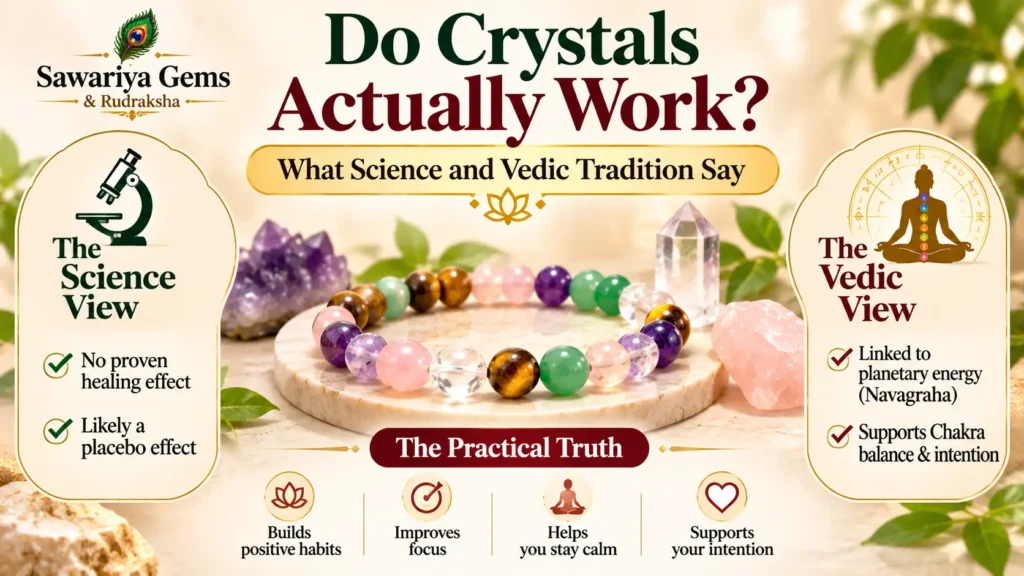
Do crystals actually work? The honest answer has two parts. Science has found no convincing evidence that crystals have healing properties of their own beyond the effect of belief and expectation. At the same time, millions of people use crystals as part of a daily ritual and report feeling calmer, more focused and more intentional. Both statements are true, and understanding how they fit together is the best way to use crystals wisely.
The short answer: when researchers compared real crystals with fakes, people reported the same sensations either way, which points to suggestion and not to the stone. Vedic tradition makes a different kind of claim, based on planetary and Chakra frameworks that science cannot currently test. The practical value of a crystal bracelet most likely lies in the ritual, attention and intention it supports, and it should never replace medical care.
Do Crystals Actually Work? What the Science Says
The most cited experiment comes from a team led by psychologist Christopher French at Goldsmiths, University of London. About 80 volunteers were asked to meditate for five minutes while holding either a real quartz crystal or a convincing fake, without knowing which they had. Some were told in advance what sensations to expect, such as tingling or warmth.
The result was clear. People reported the same kinds of sensations whether they held a real crystal or a fake one, and those who had been told what to expect reported more of them. The researchers concluded that the effects came from suggestion and belief, not from the crystals. The study was presented at a British Psychological Society conference in 2001 and has not been replicated at large scale, so it is best read as an informative experiment and not as the final word on everything.
The broader scientific position is consistent with it. French has stated that there is no evidence that crystal healing works over and above a placebo effect. In other words, there is no demonstrated physical mechanism by which a stone worn on the wrist heals the body or changes events.
Placebo Does Not Mean Nothing
It is easy to hear “placebo” and think “fake.” Researchers do not see it that way. Placebo responses are real, measurable experiences, especially for subjective things such as stress, mood, sleep quality and perceived pain. A researcher at Harvard Medical School, Ted Kaptchuk, has argued that placebo effects can be genuine and robust, although he has not studied crystals and does not comment on their legitimacy.
The honest takeaway is balanced. If a crystal helps you feel calmer because of expectation and ritual, that feeling is real, but the cause is the belief and the practice around the stone, not a property of the stone. That distinction matters, because it tells you what to expect and what not to expect.
What Vedic Tradition Actually Claims
Vedic tradition does not describe crystals as medicine. It describes them within a framework of planetary energy and the Chakra system. In this framework, each stone is associated with a Navagraha (planet) and an energy centre, and the formal Nav Ratan stones are prescribed on the basis of a birth chart. Crystal bracelets (Upratna) are used as gentler, everyday expressions of the same ideas, for example Amethyst (Jamunia) with Shani and the Crown Chakra, or Rose Quartz (Gulab Sphatik) with Shukra and the Heart Chakra.
These are traditional, metaphysical claims built up over centuries of practice. They are meaningful to the people who live by them, but they are not something laboratory science can currently confirm or refute, and astrology itself is not scientifically validated. A fair reading is to treat this as a cultural and spiritual tradition and not as a proven therapy.
Do Crystals Actually Work in Practice? Where They May Genuinely Help
Setting aside energy claims, there are ordinary psychological reasons a crystal bracelet can be useful, and none of them require believing in anything supernatural.
A cue for habit. Putting on the same bracelet before a task, a meditation or a difficult conversation becomes a signal to shift your state. Habit cues are well understood in psychology, and a small physical object makes a good one.
An anchor for attention. Feeling the stone on your wrist can bring your mind back to the present when it drifts. Many mindfulness techniques use a physical object in exactly this way.
A way to set intention. Choosing a stone for a purpose, such as calm, focus or confidence, makes you name what you want. Naming a goal and returning to it daily tends to change behaviour on its own.
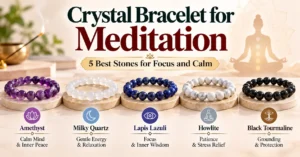
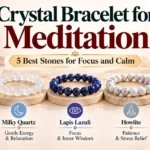
A feeling of support. During a hard period, wearing something chosen with care can feel comforting. That comfort is real even if its source is the meaning you give the object. The crystal bracelet for meditation guide shows how this works in a simple daily practice.
What Crystals Cannot Do
Crystals cannot cure disease, treat anxiety disorders or depression, replace prescribed medicine, or guarantee outcomes such as a job, a marriage or a legal result. Anyone who promises these things is overstating what the evidence supports. Where a stone helps, it helps alongside effort, treatment and good decisions, never instead of them.
The main risk is not the crystal itself but what it might displace. Researchers who study the topic, including French, have noted that a belief in crystals is unlikely to cause much harm as long as people do not give up proven medical care in favour of stones. That is the line to hold.
Claim by Claim: An Honest Scorecard
| Common Claim | Honest Assessment |
|---|---|
| Crystals cure physical or mental illness | No evidence. Do not use crystals in place of medical care. |
| A crystal bracelet helps me feel calmer | Plausible through ritual, attention and expectation. The effect is personal and not shown to come from the stone itself. |
| Crystals emit healing vibrations | No scientific support for this mechanism. |
| Stones carry planetary energy (Vedic claim) | A traditional belief that science cannot currently test. Treat it as faith and tradition. |
| Wearing a stone changes events in my life | No evidence. Outcomes depend on circumstances and effort. |
| A bracelet can be a helpful daily ritual | Reasonable and widely reported, especially for focus and mindfulness. |
How to Use Crystals Sensibly If You Still Wonder Whether Crystals Actually Work
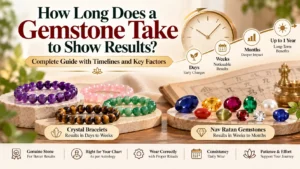
Whatever you decide about whether crystals actually work, a few simple habits keep the experience honest and useful. Treat the stone as a supportive ritual, not a treatment. Keep any medical, legal or financial decisions with the right professionals. Choose affordable stones and avoid spending money you cannot spare, especially on costly Nav Ratan stones, which should only be prescribed by a qualified Jyotishi. Be cautious of sellers who promise miracles or guaranteed results. And keep a short journal for a few weeks so you can judge for yourself whether the practice helps, which the how long a gemstone takes to show results guide explains step by step.
Authenticity matters too, since you are paying for a natural stone. Learn how to spot fakes before you buy. [Verify before publishing: add a link to your Nakli Gemstone Kaise Pehchane blog]
Where Believers and Skeptics Can Meet
You do not have to choose between blind belief and total dismissal. A skeptic can wear a bracelet as a mindfulness cue and appreciate it for what it does in practice. A believer can honour the tradition while staying clear-eyed about its limits. What both share is a wish to feel steadier, and a small, meaningful ritual can serve that wish. At Sawariya Gems, crystals and gemstones are offered as traditional, ritual and wellness objects, not as medical treatments.
Frequently Asked Questions
Do crystals actually work?
There is no convincing scientific evidence that crystals have healing properties beyond belief and expectation. In a well-known experiment, people reported the same sensations from real and fake crystals. Many people still find crystals useful as a ritual, a focus aid and a source of comfort, and that experience is real even though the stone itself is not shown to be the cause.
Is crystal healing just the placebo effect?
The best available evidence suggests the effects people report are best explained by suggestion and the placebo effect. A placebo effect is not imaginary, since it can change how stressed, calm or confident a person feels, but it comes from belief and ritual and not from a property of the crystal.
Are crystals harmful?
Crystals themselves are not harmful when worn as jewellery. The risk is using them in place of medical treatment, or spending large sums on expensive stones because of exaggerated claims. Use crystals as a complement to proper care, never as a substitute.
Do Vedic gemstones work differently from crystals?
Vedic Nav Ratan gemstones are prescribed within the Jyotish tradition, which links stones to planets and birth charts. This framework is traditional and not scientifically validated, and no gemstone is guaranteed to change life events. If you follow the tradition, consult a qualified Jyotishi, and treat the stone as faith-based support.
Why do so many people swear that crystals work for them?
Personal experience is powerful. When something positive happens while you are wearing a stone, it is natural to link the two, and ritual, expectation and comfort all contribute to how people feel. Those experiences are sincere, even if the explanation lies in psychology and not in the stone. Combining a crystal with real effort and good habits tends to give the most satisfying results, as the crystal bracelet for anxiety guide explains.
If you would like tradition-based guidance on which stone suits your Rashi and Lagna, you can use the free Janmpatri consultation at Sawariya Gems.
This article is for educational purposes. Crystals and gemstones are traditional ritual and wellness objects and are not a medical treatment. Gemstone effects are personal, subjective and not guaranteed. Always seek qualified medical, legal or financial advice for those matters, and consult a qualified Jyotishi before wearing any Nav Ratan gemstone.