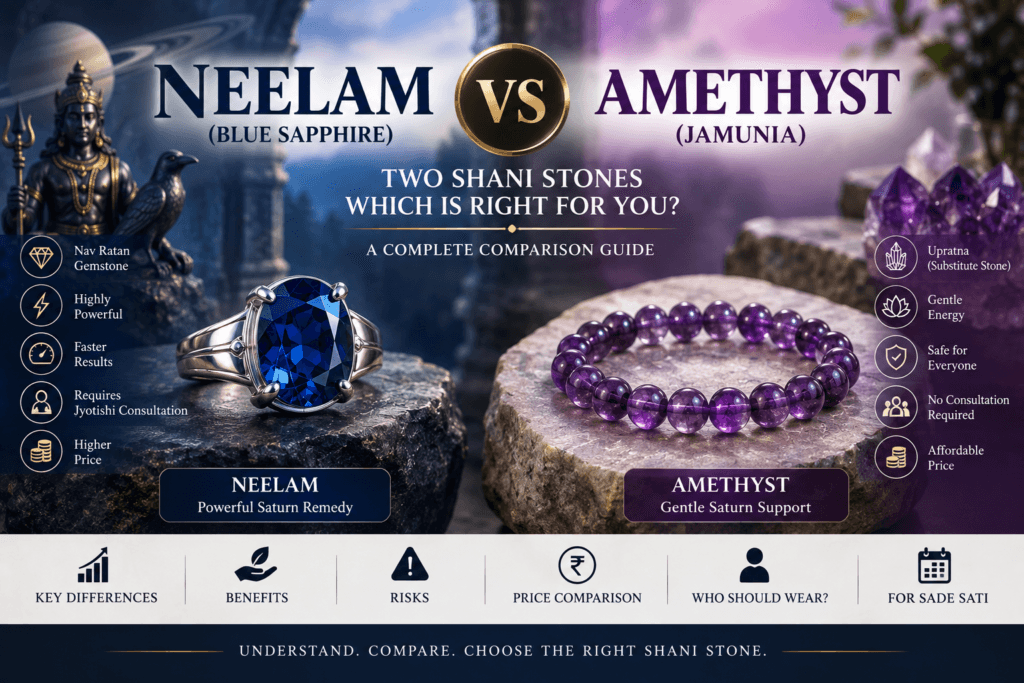
Neelam vs Amethyst is one of the most practically important comparisons in the Indian gemstone market, because both stones are associated with Shani (Saturn) and both are worn for Shani-related purposes, yet they are so fundamentally different in potency, price, risk, and appropriate use that treating them as interchangeable can lead to either a wasted purchase or a genuinely harmful one. This guide covers everything a buyer needs to know before deciding between them.
The short answer is this: Neelam (Blue Sapphire) is Shani’s primary Nav Ratan gemstone, one of the most powerful and fastest-acting stones in Vedic astrology, requiring mandatory Jyotishi consultation and a trial period before permanent wearing. Amethyst (Jamunia) is Shani’s Upratna (crystal substitute), safe for everyone, gentle in its action, accessible in price, and appropriate for daily wellness support without any prescription or trial period. Both carry Shani’s energy. They do so at entirely different intensities and through entirely different mechanisms.
What Is Neelam (Blue Sapphire)
Neelam is the Hindi and Sanskrit name for Blue Sapphire, one of the nine sacred planetary gemstones in the Vedic Nav Ratan system. It is a variety of corundum, the same mineral family as Manik (Ruby), with its blue colour produced by traces of iron and titanium within the crystal structure. Neelam is one of the hardest gemstones in existence at 9 on the Mohs hardness scale, second only to diamond, which contributes to its durability and its concentrated energetic potency.
In Vedic astrology, Neelam is Shani’s (Saturn’s) gemstone, the stone that most directly channels Saturn’s planetary frequency into the wearer’s energy field and birth chart. Shani governs karma, discipline, service, longevity, structure, and the slow, tested building of something genuinely earned. A well-placed Neelam for the right Lagna and the right chart conditions can produce dramatic positive changes in career, legal matters, protection from Shani’s harsher testing energies, and the acceleration of genuinely deserved success. It is widely considered the fastest-acting Nav Ratan gemstone.
The same speed and potency that makes Neelam powerful also makes it the most risky Nav Ratan to wear without proper Jyotishi assessment. For Lagnas where Shani rules challenging houses, wearing Neelam can intensify the planet’s difficult qualities with significant consequences. This is why classical Vedic texts consistently recommend a 72-hour trial period for Neelam before committing to permanent wearing, and why Jyotishi consultation is non-negotiable rather than advisory for this particular stone.
What Is Amethyst (Jamunia)
Amethyst (Jamunia) is a violet to deep purple variety of quartz, one of the most abundant and accessible gemstone minerals on earth. Its hardness is 7 on the Mohs scale, considerably lower than Neelam’s 9, which reflects its gentler energetic nature as well as its different geological composition. Amethyst carries Shani’s energy through a different mechanism than Neelam: not through the direct planetary transmission of a formal Nav Ratan gemstone, but through its colour frequency and its Chakra activation.
In Vedic crystal healing, violet and deep purple stones carry Shani’s colour spectrum (which includes the indigo-violet range alongside dark blue and black). Amethyst activates the Crown Chakra (Sahasrara) and Third Eye Chakra (Ajna), producing the specific Shani qualities of structured mental calm, disciplined inner awareness, and the capacity to face what is genuinely real without embellishment or avoidance. These are Shani at his most constructive: not the testing, restricting, karma-delivering Shani of difficult transits, but the still, honest, spiritually aware Shani of genuine inner discipline.
Amethyst is safe for all twelve Rashis without exception, requires no Jyotishi prescription, carries no risk of adverse effects from an incorrect Lagna placement, and is available at a fraction of the cost of quality Neelam. It does not replace Neelam for chart-level planetary remedy purposes. It provides accessible, gentle, daily Shani energy support for anyone who benefits from Saturn’s calming, structuring, and spiritually clarifying qualities in their everyday life.
Neelam vs Amethyst: Side by Side Comparison
| Feature | Neelam (Blue Sapphire) | Amethyst (Jamunia) |
|---|---|---|
| Mineral family | Corundum (aluminium oxide) | Quartz (silicon dioxide) |
| Hardness (Mohs) | 9 (extremely hard) | 7 (moderately hard) |
| Colour | Deep blue to medium blue | Violet to deep purple |
| Vedic classification | Nav Ratan (primary planetary gemstone) | Upratna (substitute crystal) |
| Planet | Shani (Saturn) direct transmission | Shani energy via colour and Chakra |
| Potency | Extremely high | Gentle and sustained |
| Speed of action | 72 hours to 3 weeks (very fast) | Gradual over weeks to months |
| Risk profile | High (wrong Lagna = serious consequences) | Negligible (safe for all) |
| Jyotishi required | Mandatory before purchase | Not required |
| Trial period | 72 hours recommended | Not needed |
| Price range | Rs 5,000 to Rs 1,00,000+ per Ratti | Rs 200 to Rs 2,000 per piece |
| Wearing method | Ring, middle finger, right hand | Bracelet (most common) |
| Best wearing day | Saturday (Shanivar) | Saturday (Shanivar) |
| Metal | Silver or Panchdhatu | Silver or any metal |
| Appropriate for | Specific Lagnas, Shani Mahadasha | All Rashis, all Dashas |
When to Choose Neelam
Choose Neelam when a qualified Jyotishi has assessed your complete birth chart, confirmed that your Lagna is one for which Shani rules a benefic house (typically Makar/Capricorn or Kumbha/Aquarius Lagna), verified that your current Mahadasha or planetary conditions make Neelam’s activation beneficial rather than harmful, and recommended a specific weight and quality. This is the complete set of conditions that must all be true before Neelam is the right choice.
Neelam is specifically indicated for people in Shani Mahadasha (Saturn’s 19-year period) whose chart makes Shani a benefic planet, for those whose weak Shani is causing specific and documented problems in the areas Saturn governs (career stagnation, legal difficulties, service sector challenges, chronic health issues in Saturn’s domains), and for Makar and Kumbha Lagna natives for whom Saturn is the Ascendant lord or rules particularly important houses.
The 72-hour Neelam trial is not optional and not superstition. It is a tested protocol from classical Vedic texts that exists because of Neelam’s unusual speed of action. Wear the stone for 72 hours after proper activation on a Saturday during Shani Hora. If the period brings positive signs (unexpected good news, increased energy, a sense of clarity and momentum), proceed with permanent wearing. If it brings negative signs (sudden arguments, illness, bad news, a sense of heaviness or dread), remove the stone immediately and consult your Jyotishi. For the complete Neelam prescription guide once it is published, see the Neelam Stone Benefits blog on Sawariya Gems.
When to Choose Amethyst
Choose Amethyst when you want daily Shani-energy support without the prescription requirement, the risk, or the significant financial investment that Neelam demands. This covers a very large group of people: anyone experiencing anxiety, overthinking, or sleep disruption linked to Shani’s demanding mental quality; anyone in Sade Sati (the 7.5-year Saturn transit period over the natal Moon) who wants supportive crystal energy without the complexity of a formal Neelam prescription; anyone wanting Crown and Third Eye Chakra calming as part of a daily wellness practice; and anyone for whom Neelam is contraindicated based on their Lagna but who still wants to work with Shani’s energy constructively.
Amethyst is also the better choice for those new to crystal healing who are still developing their understanding of how specific stones affect them personally. Starting with a gentle, universally safe Shani crystal like Amethyst builds experiential understanding of how Shani’s energy operates in the individual’s system before considering a formal Nav Ratan stone whose effects are far more intense and consequential.
For the complete Amethyst guide including how to wear, activate, and clean, read the Amethyst Bracelet Benefits guide.
Can Neelam and Amethyst Be Worn Together
Yes. For those who have received a proper Neelam prescription and are wearing Blue Sapphire as a ring on the middle finger, adding an Amethyst bracelet on the wrist is a complementary rather than conflicting practice. The two carry the same Shani energy at different intensities: Neelam delivers the chart-level planetary remedy directly; Amethyst provides the daily Crown Chakra calming that makes Saturn’s demanding Mahadasha energy more manageable at the experiential level. Many people wearing Neelam find that adding Amethyst specifically reduces the mental intensity that Shani Mahadasha can produce, without interfering with Neelam’s deeper planetary work.
The combination is particularly valuable during Shani Mahadasha’s earlier and more testing phases, when Shani’s karmic delivery can produce significant life pressure alongside the genuine long-term benefits the period is building. Neelam navigates the chart level; Amethyst supports the daily inner experience of living through it.
Frequently Asked Questions
Is Amethyst a good substitute for Neelam?
Amethyst is a widely accepted Shani Upratna (Saturn substitute) in Vedic crystal healing, and it genuinely carries Saturn’s energy through its violet colour and Crown-Third Eye Chakra activation. For the purposes of daily wellness support, spiritual development, anxiety relief, and gentle Shani energy alignment, Amethyst is an effective and completely safe option that serves real and valuable purposes in its own right. For the purpose of formal Nav Ratan planetary remedy at the birth chart level, Amethyst is a partial substitute that provides something real but cannot replicate Neelam’s direct and potent planetary transmission. The two serve different purposes; Amethyst does not fully replace Neelam for chart-level Shani work, but it provides genuine value for the wellness and Chakra support dimensions that Neelam does not specifically address.
Why is Neelam so much more expensive than Amethyst?
The price difference reflects genuine differences in rarity, hardness, and planetary potency. Neelam (Blue Sapphire) is corundum, a rare mineral requiring specific geological conditions to form with gem-quality clarity and colour. Quality natural unheated Blue Sapphire is genuinely scarce, which drives the price. Amethyst (quartz) is among the most abundant minerals on earth, occurring across many geological environments, which keeps its price accessible. Beyond supply and demand, Neelam’s extraordinary hardness (9 on Mohs), concentrated planetary potency, and the specific colour properties of fine Blue Sapphire all command premium pricing in the gemstone market. The price difference is not marketing; it reflects real differences in material and energetic value.
Can the wrong Lagna really be harmed by Neelam?
Yes, and this is not metaphysical speculation; it is consistently reported across centuries of Vedic Jyotish practice and by contemporary Jyotishis with large client bases. Neelam’s extraordinary speed of action means that for Lagnas where Shani rules challenging houses, the stone strengthens those challenging house themes with equal force to its beneficial effects on appropriate Lagnas. The 72-hour trial period exists precisely because the stone’s effects in both directions are felt quickly enough to be assessed before permanent wearing. Take the trial protocol seriously and follow your Jyotishi’s specific guidance rather than generalising from someone else’s positive Neelam experience to your own chart situation.
Which is better for Sade Sati, Neelam or Amethyst?
For Sade Sati (the 7.5-year period when Shani transits the 12th, 1st, and 2nd houses from the natal Moon), the answer depends on your Lagna. If your Lagna is appropriate for Neelam (typically Makar or Kumbha), wearing Neelam during Sade Sati provides the most direct Shani support available. For all other Lagnas where Neelam is not prescribed, Amethyst provides the daily Crown Chakra calming that reduces the mental and emotional pressure Sade Sati generates, without requiring chart-specific prescription or carrying any risk. Many Jyotishis recommend Amethyst as a universal Sade Sati support crystal precisely because its safety profile makes it appropriate for everyone going through the transit regardless of Lagna.
What is the minimum quality Neelam needed for astrological results?
The standard Jyotish guidance is natural, unheated Blue Sapphire of at least 2 Ratti (approximately 1.8 carats) with good clarity (eye-clean or near eye-clean, without major visible inclusions that break the stone’s internal structure), good colour saturation (medium to medium-deep blue without grey or green overtones), and certification from a recognised laboratory confirming natural unheated status. Heated Blue Sapphire, which comprises the vast majority of commercial sapphire supply, is considered significantly less potent for astrological purposes because the heat treatment alters the stone’s internal structure. Always insist on a GIA, IGI, or GRS certificate confirming natural unheated origin before purchasing Neelam for Vedic remedy purposes. Use the free Janmpatri consultation at Sawariya Gems to confirm whether Neelam is appropriate for your chart before making any purchase.
This guide is for educational purposes based on Vedic Jyotish tradition. Neelam (Blue Sapphire) prescription requires qualified Jyotishi assessment. Amethyst (Jamunia) is safe for general use without prescription. Individual results vary based on specific birth chart placements.