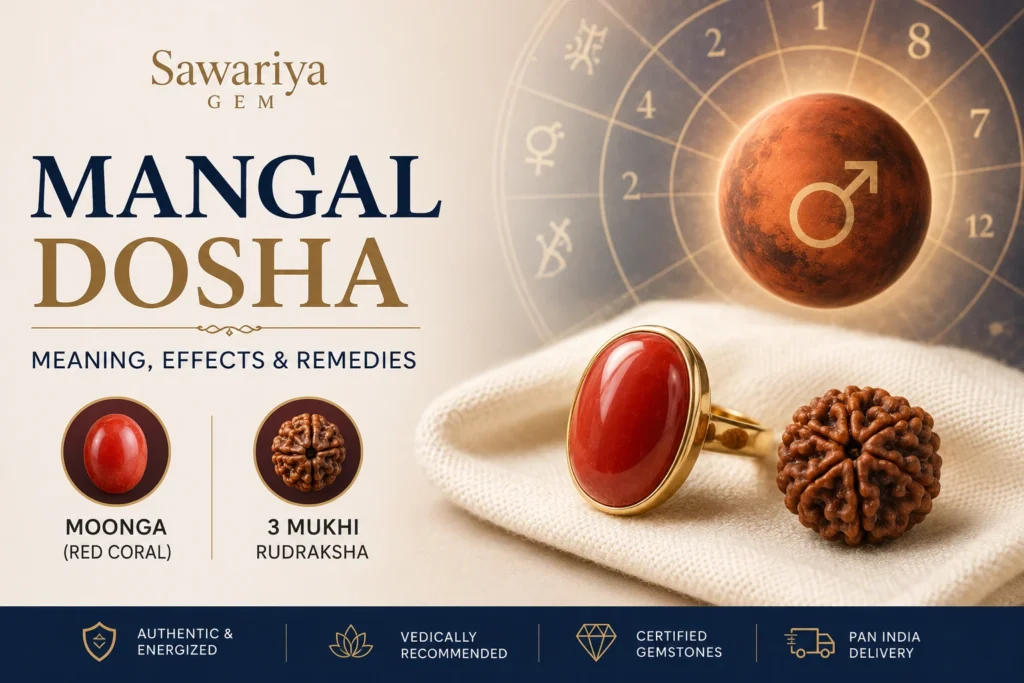
Mangal Dosha is one of the most searched and most misunderstood concepts in Vedic astrology. Thousands of people discover they have it before their wedding and immediately panic — convinced it means their marriage will be troubled, that they are incompatible with most partners, or that something is fundamentally wrong with their chart. None of that is accurate.
Mangal Dosha is simply a placement — Mars sitting in one of six specific houses in your birth chart. It creates a particular kind of intensity and directness in your energy, especially in partnerships. When channelled well, that same Mars energy is passion, vitality, and unwavering commitment. The Dosha is not a curse. It is a condition that responds well to the right remedy.
This guide explains what Mangal Dosha actually means, how to find out if you have it, and the two most effective remedies — Moonga (Red Coral) and the 3 Mukhi Rudraksha.
What Is Mangal Dosha?
In Vedic astrology, a Dosha is an unfavourable planetary condition in the birth chart — a placement that creates specific challenges if left unaddressed. Mangal Dosha (also called Kuja Dosha or Bhom Dosha in South Indian tradition) occurs when Mars is placed in the 1st, 2nd, 4th, 7th, 8th, or 12th house of the birth chart.
These houses are particularly sensitive because they govern the most intimate areas of life — the self and physical body (1st house), family and speech (2nd), home and emotional security (4th), the primary partnership and marriage (7th), longevity and hidden matters (8th), and the bedroom and spiritual liberation (12th). Mars in any of these positions brings its characteristic energy — intense, direct, impatient, driven — into those domains of life.
The 7th house placement is considered the most significant because the 7th house directly governs marriage and partnerships. Mars in the 7th brings fire into the space that requires the most softness and compromise. The 8th house placement is also considered strong because it introduces Mars energy into areas of life involving sudden change, transformation, and shared resources.
Different schools of Vedic Jyotish calculate Mangal Dosha from different reference points — some from the Lagna (ascendant), some from the Moon, and some from Venus. Depending on which method your Jyotishi uses, the same chart can show Dosha in one calculation and not another. This is one reason why a proper Janmpatri reading matters more than any generic online calculator.
How Common Is Mangal Dosha?
More common than most people realise. When calculated from all three reference points — Lagna, Moon, and Venus — a significant portion of the population carries some form of Mangal Dosha. Estimates range from 40 to 60 percent depending on the calculation method.
This is worth sitting with for a moment. If Mangal Dosha were truly the catastrophic marital curse it is sometimes presented as, that percentage of the human population would be incapable of happy marriages. Clearly that is not the case. Thousands of stable, loving, long marriages belong to people with strong Mangal Dosha in their charts.
The Dosha creates a tendency — not a destiny. And tendencies respond to remedies.
Anshik Mangal Dosha vs Poorn Mangal Dosha
Not all Mangal Dosha is equal in strength. Vedic Jyotish distinguishes between degrees of the condition:
Poorn (Full) Mangal Dosha — Mars in the 7th or 8th house of the Lagna chart, unmitigated by any benefic aspect or conjunction. This is the strongest form and the one most commonly associated with the Dosha’s challenging effects in partnerships. It requires clear remedy.
Anshik (Partial) Mangal Dosha — Mars in the 1st, 2nd, 4th, or 12th house, or in the 7th/8th house but with mitigating factors — aspected by Jupiter, conjoined with a benefic planet, or placed in its own sign (Aries, Scorpio) or exaltation sign (Capricorn). This is a weaker form that may require less intensive remedy.
Cancellation conditions (Dosha Nivaran) — In some chart configurations, Mangal Dosha cancels itself. This happens when both partners have Mangal Dosha of similar strength (the classic “Manglik + Manglik” match), when Mars is in its own or exalted sign, when Jupiter aspects Mars in the 7th or 8th house, or when Mars is conjoined with certain benefic planets. Again — this is why a proper chart reading matters far more than a yes/no online result.
What Mangal Dosha Actually Creates — in Plain Terms
The specific challenges that Mangal Dosha tends to produce — when unaddressed — are worth understanding honestly, because they are neither as dramatic as people fear nor as trivial as they are sometimes dismissed.
In relationships and marriage, strong Mangal Dosha often manifests as a high degree of personal intensity that can be difficult for a partner to match or absorb. The person may have strong opinions, a low tolerance for what they perceive as passivity or indecision, and a communication style that can come across as confrontational even when the intention is simply direct. Conflicts may be frequent and can escalate faster than in a chart without this placement.
In the physical body, Mars governs the blood, muscles, and the body’s inflammatory responses. Some people with strong Mangal Dosha experience more frequent injuries, higher blood pressure tendencies, or a physical restlessness that does not discharge well without regular physical activity.
In practical life, Mangal Dosha can create delays or complications specifically around marriage — difficulty finding a compatible partner, relationships that come close to commitment but do not materialise, or opposition from family members. This is the aspect that most often brings people to an astrologer.
None of these are fixed outcomes. They are the terrain of the chart — the specific challenges that the right remedies directly address.
Moonga (Red Coral) for Mangal Dosha — How It Works
Moonga — Red Coral — is the Mangal Ratna, the gemstone of Mars. It is an organic gemstone made of calcium carbonate from marine coral polyps, and in Vedic astrological tradition it is considered the most direct way to strengthen and balance Mars energy in the birth chart.
The logic of gemstone remedy in Vedic astrology is specific: a gemstone does not suppress a planet’s energy. It strengthens and refines it. Moonga does not make Mars quieter or less intense. It channels Mars’s fire into its constructive expressions — courage, decisiveness, physical vitality, and the ability to commit fully — and reduces its destructive expressions — aggression, impulsiveness, and the kind of intensity that creates friction in close relationships.
For Mangal Dosha specifically, wearing Moonga creates a kind of internal regulation of Mars energy. People who have worn Moonga for Mangal Dosha consistently describe the same shifts: arguments that previously escalated without warning begin to resolve more quickly. The physical restlessness that had no outlet begins to channel into productive action. The sense of impatience in relationships softens — not to indifference, but to a more sustainable directness.
Our Red Coral (Moonga) has the complete quality guide, how to identify genuine coral from bamboo coral fakes, the full ritual, and the recommended Ratti for Mangal Dosha cases specifically.
How to Wear Moonga for Mangal Dosha — Key Points
For Mangal Dosha specifically, the weight matters more than for general Mars strengthening. A general Mars remedy might use 3 Ratti — for Mangal Dosha, 6 to 9 Ratti is the standard recommendation, because the Dosha requires a stronger, more sustained planetary correction.
Metal: Gold or Panchdhatu. Copper is sometimes specifically prescribed for Mangal Dosha cases — confirm with your Jyotishi.
Finger: The Anamika (ring finger) or Tarjani (index finger) of the right hand.
Day: Tuesday (Mangalvar) at sunrise, during Shukla Paksha.
Mantra: Om Kraam Kreem Kraum Sah Bhaumaya Namah — 108 times at first wearing.
One additional practice specifically for Mangal Dosha: reciting Hanuman Chalisa on Tuesdays alongside wearing Moonga is considered especially powerful. Hanuman is the deity associated with Mars in Vedic tradition — and the combination of the physical gemstone remedy with the devotional practice creates a more complete approach than the stone alone.
3 Mukhi Rudraksha — The Rudraksha Remedy for Mangal Dosha
Moonga is the gemstone approach to Mars remedy. The Rudraksha tradition offers a parallel path through the 3 Mukhi Rudraksha — the three-faced bead ruled by Mars and associated with the fire deity Agni.
The 3 Mukhi Rudraksha addresses Mars from a different angle than Moonga. Where Moonga works primarily on strengthening and refining Mars’s planetary energy through the gemstone-to-planet channel, the 3 Mukhi works on the karmic and psychological roots of Mars affliction — specifically the patterns of anger, guilt, and unresolved past action that are associated with a challenged Mars in the chart.
Many Jyotishis recommend wearing both the Moonga and the 3 Mukhi Rudraksha simultaneously for Mangal Dosha remedy — the gemstone addressing the planetary energy and the Rudraksha addressing the karmic and psychological dimension. They are compatible and mutually reinforcing.
Does the Partner Also Need a Remedy?
This is one of the most frequently asked questions — and the honest answer is: it depends on the specific charts.
The traditional advice in Vedic Jyotish is that a person with strong Mangal Dosha ideally marries another person who also has Mangal Dosha — because the matched Mars energies balance each other rather than creating an imbalance where one partner’s intensity overwhelms the other’s more measured nature. This is called Dosha Samya — equality of the Dosha.
In modern practice, this is not always possible or practical. Many happy marriages exist between a Manglik partner and a non-Manglik one. In these cases, the remedies for the Manglik partner are more important — because the work is to refine and moderate the Mars energy so it does not overwhelm the partnership dynamic.
Some astrologers also recommend specific remedies for the non-Manglik partner to strengthen their own planetary resilience. If marriage is pending and both partners’ charts are available, a combined Janmpatri reading that looks at both charts together is the most useful approach. Our free Janmpatri consultation covers this — bring both birth details and we assess the Dosha balance between the charts.
Mangal Dosha and Marriage Timing — What to Realistically Expect
People often want a specific answer: will wearing Moonga fix the Mangal Dosha problem in my marriage? The honest answer is layered.
Moonga is a remedy — not a removal. The Dosha does not disappear from the chart when you wear the stone. What changes is your relationship with Mars energy — how it expresses, how you channel it, how it affects your interactions with the people closest to you.
For people experiencing delayed marriage specifically because of Mangal Dosha, wearing Moonga alongside the 3 Mukhi Rudraksha typically begins to produce movement in marriage-related situations within 3 to 6 months. Not always immediate marriage — but often a qualitative shift in how those situations are developing.
If delayed marriage is the primary concern and Jupiter is also weak in the chart, combining Moonga with Pukhraj (Yellow Sapphire) addresses both the Mars obstruction and the Jupiter weakness that governs marriage timing. Read our complete Pukhraj guide for the Jupiter side of this combination.
Frequently Asked Questions
How do I know if I have Mangal Dosha?
You need your birth chart — specifically your Janam Kundali — with the house positions of all planets calculated. If Mars appears in the 1st, 2nd, 4th, 7th, 8th, or 12th house from your Lagna (ascendant), Moon sign, or Venus, you may have Mangal Dosha. Because different Jyotishis calculate from different reference points, and because cancellation conditions are complex, a proper reading matters far more than an online calculator. Our free Janmpatri consultation will assess Mangal Dosha clearly and tell you whether remedy is needed.
Is Mangal Dosha dangerous for marriage?
No — not inherently. Mangal Dosha creates specific tendencies in relationship dynamics, particularly around intensity, directness, and conflict. With the right remedies and self-awareness, people with strong Mangal Dosha have deeply committed, loving marriages. The Dosha is a condition, not a fate. Thousands of happily married people carry it in their charts.
Which is better for Mangal Dosha — Moonga or 3 Mukhi Rudraksha?
Both address Mars from different angles and are most effective when used together. Moonga (Red Coral) works through the gemstone-to-planet channel, strengthening and refining Mars energy directly. The 3 Mukhi Rudraksha addresses the karmic and psychological roots of Mars affliction — anger, past actions, and the fire-energy patterns associated with a challenged Mars. Many Jyotishis recommend both simultaneously for Mangal Dosha cases.
How many Ratti of Moonga should I wear for Mangal Dosha?
For Mangal Dosha remedy specifically, 6 to 9 Ratti is the standard recommendation — higher than the 3 Ratti used for general Mars strengthening. The Dosha requires a stronger, more sustained planetary correction than a simple weak Mars placement. The exact weight for your chart can be confirmed through a Janmpatri reading.
Can Mangal Dosha be cancelled or nullified?
Yes, in specific conditions. Mars in its own sign (Aries or Scorpio), Mars in its exaltation sign (Capricorn), Mars aspected by Jupiter, both partners having Mangal Dosha of similar strength, or Mars conjoined with certain benefic planets — all of these can cancel or significantly reduce the Dosha’s effect. Whether these cancellation conditions apply to your chart requires a proper Janmpatri analysis, not a generic online tool.
Should both partners do a Mangal Dosha check before marriage?
Yes. Both charts should be examined — not just for Mangal Dosha presence, but for Dosha balance between the two charts (Dosha Samya), the overall compatibility of the charts, and whether the Dosha in one chart is cancelled or mitigated by placements in the other. A combined reading of both birth charts before marriage is one of the most valuable things Vedic Jyotish offers prospective couples.