Of the nine planetary periods in the Vimshottari Dasha system, Rahu Mahadasha is the one people describe most vividly when they are in it. Not always with clarity , that is part of the problem but with a specific quality of intensity that is hard to confuse with anything else. The desperate energy. The feeling of chasing something important that keeps moving just out of reach. The sense that ordinary rules no longer quite apply and that life has shifted into a strange, accelerated mode that is neither fully good nor fully bad but is relentlessly intense.
“Rahu tumhe picture dikhayega”, Rahu will make you watch a movie. Depending upon their karma, Rahu can make them watch a happy movie full of growth and rapid rise, or can make them see a horror movie. However, in most cases, in the end, all that Rahu promises turns out to be smokes and mirrors. That single metaphor from one of India’s most respected Jyotishis explains why so many people arrive at a Vedic consultation confused about a period that felt like it was going brilliantly right up until it wasn’t.
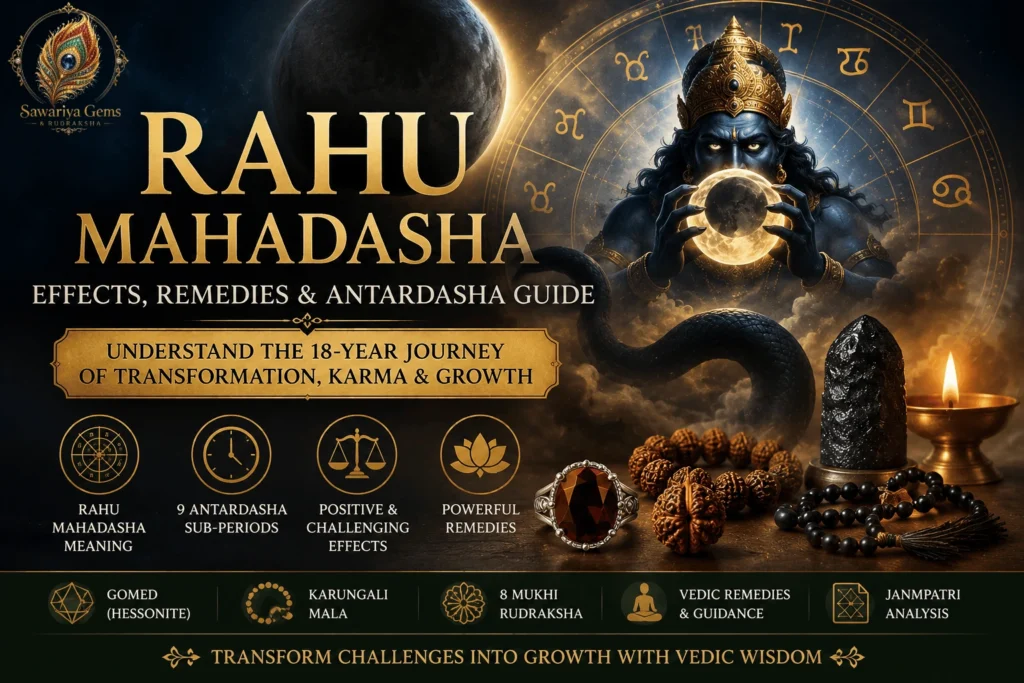
This guide covers what Rahu Mahadasha actually is, the nine Antardasha sub-periods and what each one typically brings, what the most difficult periods look like, the remedies that consistently help and how Gomed (Hessonite), Karungali Mala, and the 8 Mukhi Rudraksha each address Rahu’s influence from different traditional angles.
What Is Rahu — Before Understanding the Mahadasha
Rahu is not a planet in the physical sense. It is the North Node of the Moon. the point where the Moon’s orbital path crosses the ecliptic on its northward journey. In Vedic cosmology, this astronomically real point is given full planetary status and treated as one of the most influential forces in a birth chart.
Rahu is known as a shadow planet in Vedic astrology. Unlike visible planets, it does not possess a physical body but carries immense karmic power. Rahu symbolizes obsession, illusion, sudden rise, foreign connections, and deep unfulfilled desires. It has no sign of its own rulership, no house of its own, no inherent dignity, which makes it entirely dependent on context. Where it sits in a birth chart, which planets it is conjunct or aspected by, and whether those planets are strong or weak: these factors determine whether Rahu Mahadasha becomes the most productive 18 years of a person’s life or the most destabilising.
Rahu’s domains in Vedic astrology span an unusually wide range: technology, foreign travel and connections, mass media and fame, the occult and hidden knowledge, material ambition, illusion and deception, sudden gains and sudden losses, unconventional paths, and the deep karmic patterns from past lives that the soul came to confront and resolve in this lifetime. This breadth is why Rahu Mahadasha can look so different from one person to the next — the same 18 years that built one person’s international career shattered another’s marriage and savings.
Rahu Mahadasha — Duration, Timing, and Who Has It When
Rahu Mahadasha is the 18-year planetary period in the Vimshottari Dasha system during which Rahu becomes the dominant influence on your life. The total Vimshottari cycle is 120 years; Rahu’s 18-year share is the third-longest of the 9 planetary periods (after Venus’s 20 years and Saturn’s 19 years).
The Vimshottari Dasha sequence is fixed: Ketu (7 years) → Venus (20 years) → Sun (6 years) → Moon (10 years) → Mars (7 years) → Rahu (18 years) → Jupiter (16 years) → Saturn (19 years) → Mercury (17 years). The starting point depends on the nakshatra your natal Moon occupied at birth.
If you were born with your Moon in Ardra, Swati, or Shatabhisha nakshatra, you began life in Rahu Mahadasha. For most people, Rahu Mahadasha arrives after a sequence of earlier Dashas have run — which means the timing varies enormously from person to person.
A useful rough guide: people born in Mars nakshatra (Mrigashira, Chitra, Dhanishta) typically encounter Rahu Mahadasha in their 30s to 40s — often exactly the period when career and family pressures peak. People born in Moon nakshatra (Rohini, Hasta, Shravana) often encounter Rahu in their 20s — when foundational life choices are being made with the least experience. People born in Venus nakshatra may not enter Rahu Mahadasha until their 50s or 60s.
The only way to know exactly when your Rahu Mahadasha runs — or where you are within it — is a proper Janmpatri calculation. Use our free Janmpatri consultation to confirm your Dasha timeline and get chart-specific guidance alongside this general guide.
The Nine Antardasha Sub-Periods — What Each One Brings
Within the 18-year Rahu Mahadasha, each of the nine planets runs its own sub-period (Antardasha). These sub-periods are not equal in length and they each modify Rahu’s energy significantly. Understanding which Antardasha you are in is often more practically useful than the broad Mahadasha label.
Rahu-Rahu (2 years 8 months)
The most intensely Rahu period — maximum amplification of obsession, ambition, and the desire to achieve beyond one’s origins. Foreign travel, technology, and unconventional paths open dramatically. This is the opening of the Mahadasha and often sets the dominant tone for the whole period. What you chase during Rahu-Rahu will tend to define the next 15+ years. The intensity is real — and so are the potential mistakes made from urgency and impatience.
Rahu-Jupiter (2 years 4 months 24 days)
The native gets a lot of fame and status during this period due to the beneficial presence of Jupiter. New energy enters to defeat the old spirit and succeed in efforts. Career growth, promotion and real achievement are possible. This is often the most auspicious sub-period within Rahu Mahadasha for those with a well-placed Jupiter — wisdom guides Rahu’s ambition and produces lasting results rather than merely fast ones.
Rahu-Saturn (2 years 10 months 6 days)
The longest antardasha in Rahu Mahadasha and among the most demanding. Rahu’s desire for rapid achievement meets Saturn’s insistence on slow, karma-based progress — creating frustration, delays, and the need for sustained disciplined effort over an extended period. However, for those who work with both energies — ambitious but patient, unconventional but structured — this is when genuinely durable achievements are built. Many people find this the hardest sub-period of the entire Mahadasha. The remedies section below addresses this specifically.
Rahu-Mercury (2 years 6 months 18 days)
Mercury’s presence helps in coming out of trouble. Knowledge and wisdom improve, helping in making the right choices in life. Positive for education, business communication, and analytical work. This is typically one of the more manageable sub-periods — Mercury sharpens Rahu’s intelligence and gives direction to its restless energy.
Rahu-Ketu (1 year 0 months 18 days)
The nodal axis antardasha is one of the most spiritually significant phases in Rahu Mahadasha. Ketu forces a confrontation with what Rahu has been relentlessly pursuing — creating sudden disillusionment, spiritual awakenings, or life-direction changes. The native may experience sudden losses, separations, or unexpected wisdom from crisis. This has been called the period of Karmic Retribution — free will is at its minimum and the hand of destiny takes over. There is only one guarantee: whatever one has planned will not happen. This period warrants specific protective remedies.
Rahu-Venus (3 years 0 months)
Venus brings beauty, relationships, luxury, creative achievement, and material satisfaction to Rahu’s ambitious field. Foreign luxury goods, international artistic success, cross-cultural marriages, and significant material accumulation are all possible. This is frequently when the native’s worldly status peaks within Rahu Mahadasha. The longest and often most materially comfortable sub-period.
Rahu-Sun (10 months 24 days)
Sun and Rahu together create tension between legitimate authority and Rahu’s tendency to circumvent authority. Career advancement through unconventional means, conflict with father or government authorities, and intense ambition for recognition are all characteristic. Keep interactions with authority figures carefully honest during this sub-period.
Rahu-Moon (1 year 6 months)
This phase is generally considered difficult. A person may feel lonely, depressed or face stress in relationships. There may be fears related to water, snakes or sudden accidents. In some cases, it can lead to harmful thoughts or bad company. The Moon-Rahu axis creates a specific kind of emotional turbulence — Rahu’s forward-obsessed energy colliding with the Moon’s need for emotional security. Karungali Mala’s combination of Rahu-grounding wood and Chandra Dhatu silver is specifically appropriate during this sub-period.
Rahu-Mars (1 year 0 months 18 days)
Mars’s antardasha in Rahu’s Mahadasha increases aggressive tendencies. Legal issues and the possibility of accidents are more likely during this period. Loss of money and status are possible. The spouse is often in disputes with the family. Avoid unnecessary confrontations, legal risk, and physical recklessness during this sub-period.
What Rahu Mahadasha Actually Feels Like
Beyond the Antardasha sequence, there are experiential patterns that recur across almost everyone in Rahu Mahadasha regardless of their chart specifics. Recognising these patterns is often the first step toward navigating them consciously rather than being driven by them.
The acceleration quality. Things that would have taken years to develop seem to happen in months. New people, new cities, new industries, new identities — Rahu compresses timelines and creates the feeling that ordinary life is moving in fast-forward. This can feel exhilarating initially and exhausting over time.
The hunger that does not satisfy. During Rahu period, people become desperate, chase illusions, become selfish and cynical, almost possessed by passion and have a rebellious streak. There is a specific quality of desire during Rahu Mahadasha — an intensity that persists even when the thing being desired is obtained. The goal is achieved and then immediately feels insufficient, pointing toward the next thing. This is the mechanism through which Rahu teaches its karmic lesson about the nature of material desire.
Confusion about what is real. Rahu’s association with illusion (Maya) creates a specific clarity problem during its Mahadasha — it is genuinely difficult to assess situations accurately, particularly the motivations of people who appear suddenly and promise much. What looks like an extraordinary opportunity may be a trap. What looks like a problem may be a disguised doorway. The discernment capacity that would ordinarily help navigate this tends to be unreliable during Rahu’s period.
The foreign element. Almost universally, Rahu Mahadasha involves some significant contact with what is foreign — foreign people, foreign places, foreign industries, foreign ways of thinking. This can be literally international travel or relocation, or it can be a career shift into an unfamiliar field, a relationship with someone from a different background, or an encounter with ideas and philosophies very different from one’s origin.
The sudden reversal pattern. The same 18 years that make one person a self-made multi-millionaire devastate another financially. Well-placed Rahu in a Kendra or trinal house often produces sudden material rise; poorly-placed Rahu produces sudden losses, deceptions, addictions, mental health challenges, and karmic crises. The reversals themselves — whether from low to high or high to low — tend to happen with a speed and unexpectedness that is distinctly Rahu’s.
Rahu Mahadasha and Career — The Unconventional Path
Career transformation is one of the most noticeable themes during Rahu Mahadasha. Rahu is associated with modern industries, foreign connections, and unconventional professional paths. Sudden career breakthroughs may occur in digital industries, media, research, or politics. Foreign job opportunities or international relocation may appear. Strong ambition can push individuals toward extreme work dedication.
Careers that do particularly well during Rahu Mahadasha include technology, mass media, film and entertainment, politics (particularly populist or outsider politics), research and investigation, import-export and international trade, the occult and spiritual industry, and any field that involves working with large numbers of people at once — Rahu is the planet of the mass and the crowd.
Careers that tend to struggle or require extraordinary care during Rahu Mahadasha include anything requiring stable, methodical authority — roles where your credibility depends on never appearing erratic or unpredictable, since Rahu’s energy tends toward the unconventional even when that is professionally costly.
Rahu Mahadasha and Relationships — The Complication
Relationships during Rahu Mahadasha follow the same pattern of intensity and instability that characterises the period overall. Rahu’s influence in relationships tends to bring:
Attractions to people who are different from one’s background — different culture, different religion, different socioeconomic position, different worldview. These relationships can be genuinely transformative and also genuinely complicated in ways that more conventional relationships are not.
A specific kind of emotional unavailability — not cruelty but a preoccupation with external ambition that makes sustained relational presence difficult. The Rahu Mahadasha person is typically oriented outward, toward the next achievement, which leaves partners and family feeling secondary.
For those in Rahu-Moon Antardasha specifically, emotional turbulence in close relationships reaches a peak. The remedies below — particularly the Karungali Mala with its silver cap (Chandra Dhatu) dimension — are most relevant during this sub-period for the emotional stability and relational steadiness they support.
Rahu Mahadasha Remedies — The Complete Picture
Vedic astrological remedy for Rahu operates on several levels simultaneously — the planetary energy level (gemstone and Rudraksha), the deity level (mantra and worship), the lifestyle and ethical level (behavioural changes that appease Rahu), and the protective energy level (stones and malas that shield against Rahu’s more destabilising influences). The most effective remedy plans combine all four levels.
Gomed (Hessonite) — Rahu’s Navratna Gemstone
The gemstone for Rahu Mahadasha in Vedic astrology is Hessonite (called Gomed in Sanskrit/Hindi) — a honey-orange-brown variety of garnet that classical Vedic gemstone texts identify as Rahu’s specific stone for the 18-year Rahu Mahadasha period.
Gomed works at the planetary energy level — strengthening and refining Rahu’s influence in the birth chart so that its constructive expressions (ambition, innovation, foreign success) are amplified and its destructive ones (confusion, obsession, sudden loss) are moderated. The oil-in-water test for identifying genuine Gomed, quality factors to consider, and full wearing ritual are covered in our complete Gomed Benefits and Identification guide.
Important note: Gomed, like all Nav Ratan gemstones, should be worn only after confirming that Rahu is genuinely the primary issue in your chart through a proper Janmpatri reading. Use our free Janmpatri consultation before purchasing Gomed specifically.
8 Mukhi Rudraksha — Ganesha’s Obstacle-Removing Bead
The 8 Mukhi Rudraksha is the Rudraksha bead most directly associated with Rahu and Ganesha — Lord Ganesha being the deity who removes obstacles and clears the path forward. During Rahu Mahadasha, when inexplicable obstacles and misdirection are among the most common challenges, the 8 Mukhi’s specific association with obstacle removal makes it the primary Rudraksha recommendation for this period.
Wear it on a Saturday or Wednesday, energised with the mantra Om Hreem Namah or the Ganesha mantra Om Gam Ganapataye Namah. The 8 Mukhi does not require a birth chart assessment for wearing — unlike Gomed, which does — making it the more accessible starting point for someone in Rahu Mahadasha before they have had a full chart reading.
Karungali Mala with Silver Cap — Traditional Protective Wood
Our Karungali Mala with Silver Cap — 54 beads of natural Black Ebony with silver-capped ends — works as a protective and grounding companion for Rahu Mahadasha in the Tamil Siddha and Vedic tradition.
Where Gomed works at the planetary chart level and the 8 Mukhi works through Ganesha’s deity connection, Karungali works through earth energy — the dense, grounding quality of natural ebony that absorbs and neutralises the turbulent, scattered, or confused energy that Rahu’s period generates. The silver caps add Chandra Dhatu’s emotional steadying quality, which is particularly relevant during Rahu-Moon Antardasha when the Moon-Rahu axis creates the most emotional turbulence.
Karungali Mala is appropriate for all Rashis during Rahu Mahadasha as a protective and grounding piece without requiring a chart assessment — it does not intensify Rahu’s energy but rather stabilises the wearer’s response to it.
Sulemani Hakik Bracelet — Daily Protection Layer
For daily wearable protection against the buri nazar and negative external attention that often accompanies Rahu Mahadasha’s periods of visible success, our Sulemani Hakik Bracelet (Black Chalcedony) adds the most traditional Indian protection layer. During Rahu Mahadasha, when visibility and attention increase, the traditional Indian concern about negative external energy becoming more relevant — Sulemani Hakik addresses this at the wrist while Karungali Mala addresses it at the neck level.
Mantra — Rahu Beej Mantra and Durga Mantra
The primary mantra for Rahu remedy during Mahadasha is: Om Bhraam Bhreem Bhraum Sah Rahave Namah — 108 repetitions daily, on Saturdays and Wednesdays which are Rahu’s most auspicious days.
The Durga Saptashati recitation is also widely recommended by Jyotishis for Rahu Mahadasha management — particularly during the difficult sub-periods (Rahu-Ketu, Rahu-Moon, Rahu-Saturn) where Rahu’s energy feels most destabilising.
Behavioural Remedies — What Rahu Responds To
Rahu’s karmic lesson during its Mahadasha involves the relationship between ambition and integrity — the tendency to pursue ends without examining means, to cut corners, to use people as instruments. The traditional behavioural remedies for Rahu reflect this:
Maintain integrity and honesty in all dealings to prevent misunderstandings and conflicts. Follow ethical practices in personal and professional life. This is not moral advice in the generic sense — it is specifically practical for Rahu Mahadasha, because Rahu’s period tends to expose ethical shortcuts with consequences that are disproportionate to the shortcut taken.
Donating black sesame seeds (kala til) on Saturdays. Feeding stray dogs — Rahu’s animal is the dog in Vedic tradition. Avoiding alcohol and intoxicants — substances that amplify Rahu’s confusion quality. Spending time regularly in nature rather than exclusively in technology and urban environments.
After Rahu Mahadasha — What Comes Next
After Rahu Mahadasha, the next Mahadasha that comes is Jupiter (Guru) Mahadasha, as per the Vimshottari Dasha system. This change is very important because the energy of life shifts completely. Rahu’s period is full of desires, illusions, sudden ups and downs and strong ambitions. When Jupiter takes over, it brings more wisdom, knowledge and a sense of peace. During Jupiter Mahadasha, people usually feel more stable in life. It helps in making wiser decisions, focusing on education, spiritual growth, family happiness and long-term stability.
The transition from Rahu to Jupiter Mahadasha is one of the most dramatic shifts in the Vimshottari system — from shadow planet to the greatest natural benefic. Many people who struggled through Rahu Mahadasha describe the beginning of Jupiter Mahadasha as a literal lightening, as though a heavy weight has been removed. The wisdom and growth achieved during Rahu’s 18 years — despite their difficulty — tend to show their real value during the Jupiter period that follows.
Getting Chart-Specific Guidance
This guide covers the general pattern of Rahu Mahadasha across all charts. But the most practically useful guidance is always chart-specific — knowing which house your Rahu occupies, which planets it is conjunct or aspected by, and how this maps onto your current Antardasha is essential for understanding what the next months and years will actually look like and which remedies will be most effective.
Our free Janmpatri consultation covers exactly this — your Rahu placement, current and upcoming Antardasha, and the specific gem, Rudraksha, or combination remedy most appropriate for your situation. No charge, no obligation, and no gemstone recommendation without first reading your chart.
Frequently Asked Questions
How do I know if I am in Rahu Mahadasha?
You need your birth date, time, and place to calculate your current Dasha. The Rahu Mahadasha runs for 18 years and its timing depends on which nakshatra your natal Moon occupied at birth. People with their natal Moon in Ardra, Swati, or Shatabhisha nakshatras begin life in Rahu Mahadasha. For everyone else, it arrives after a sequence of earlier Dashas have run. Use our free Janmpatri consultation to confirm your current Dasha and Antardasha.
Is Rahu Mahadasha always bad?
No — and this is the most important point to understand. Rahu Mahadasha’s outcome depends entirely on Rahu’s placement in the birth chart. Well-placed Rahu in Kendra (1st, 4th, 7th, 10th) or trine (1st, 5th, 9th) houses often produces extraordinary worldly success — sudden fame, career breakthroughs, foreign success, wealth through technology or media. The same period with poorly-placed Rahu can be genuinely difficult. The period is intense regardless — but intensity is not the same as bad.
What is the worst Antardasha within Rahu Mahadasha?
Rahu-Ketu Antardasha (approximately 1 year) is widely considered the most challenging sub-period within Rahu Mahadasha. The nodal axis creates sudden disillusionment, unexpected losses, and the confrontation of whatever Rahu has been chasing with Ketu’s harsh clarity about whether it is actually worth pursuing. Rahu-Saturn Antardasha (approximately 2 years 10 months) is the longest and often the most grinding, combining Rahu’s ambition with Saturn’s delays.
Which gemstone should I wear during Rahu Mahadasha?
Gomed (Hessonite) is Rahu’s Nav Ratan gemstone — it should be worn only after confirming through a proper Janmpatri reading that Rahu is genuinely the primary issue in your chart, since the wrong gemstone can intensify a problematic planet rather than balance it. The 8 Mukhi Rudraksha and Karungali Mala are safer starting points that can be worn without a chart assessment. See our Gomed guide, 8 Mukhi product page, and Karungali Mala for full details on each approach.
Can Rahu Mahadasha be good for career?
Yes — for those with favourably placed Rahu, career growth during Rahu Mahadasha can be extraordinary. Technology, mass media, international business, politics, and the entertainment industry all tend to respond particularly well to Rahu’s energy. The career growth tends to be fast and unconventional rather than slow and structured — which can be both the opportunity and the risk.
What mantra should I chant during Rahu Mahadasha?
The primary Rahu Beej Mantra: Om Bhraam Bhreem Bhraum Sah Rahave Namah — 108 repetitions daily, best performed on Saturdays and Wednesdays. The Ganesha mantra Om Gam Ganapataye Namah is also specifically recommended, as Ganesha (associated with the 8 Mukhi Rudraksha) is the deity of obstacle removal and is particularly relevant during Rahu’s tendency to create inexplicable obstacles.