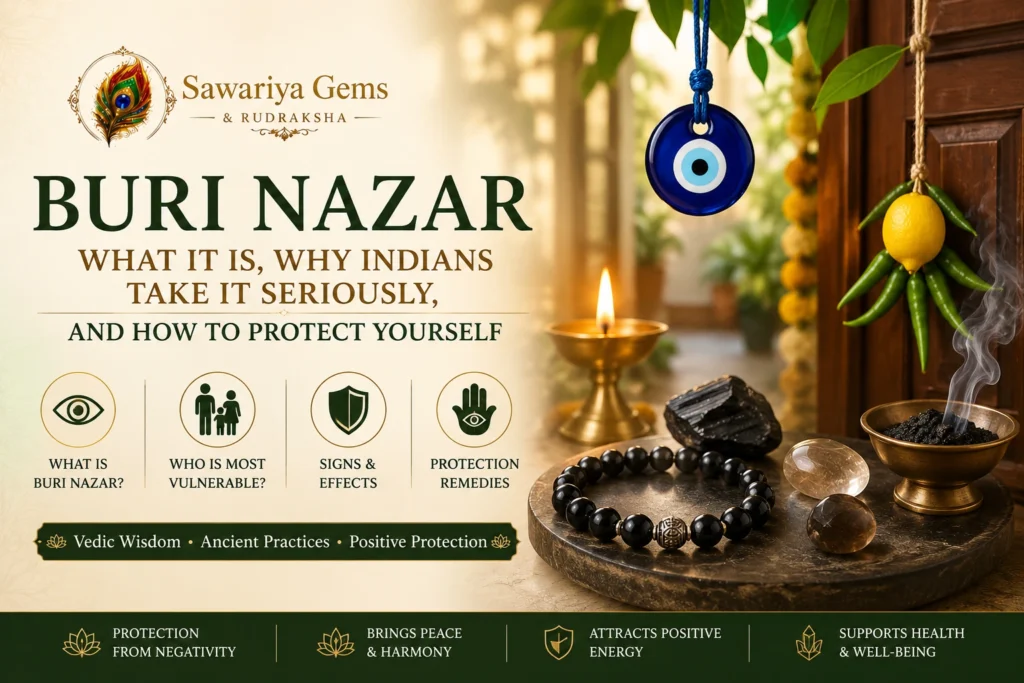
Buri nazar is one of those things most Indian families practice without ever fully explaining. The lemon and green chilli hanging at the shop entrance. The black thread on a newborn’s wrist. The small black dot behind a child’s ear. The nimbu mirchi totem at the main door of the house that is replaced every Saturday. These practices exist quietly in the background of Indian life — inherited rather than taught, understood without being articulated.
This guide explains what buri nazar actually is according to Vedic tradition, why so many educated, modern Indian families continue to take it seriously, and the most effective protection methods available — from the folk practices passed down through generations to the crystals and gemstones with the strongest traditional protective associations.
What Is Buri Nazar — The Real Explanation
Buri nazar literally translates as “bad eye” in Hindi — buri meaning bad or evil, nazar meaning gaze or sight. In Vedic and folk tradition, it refers to the belief that a person’s gaze — particularly when it carries intense envy, admiration, or ill-wishing — can transmit negative energy to the person or thing being looked at, causing harm, disruption, or a reversal of good fortune.
The concept is not unique to India. It appears across an extraordinary range of cultures and historical periods — as the malocchio in Italy, the mal de ojo in Latin America, the ayin hara in Jewish tradition, the nazar in Turkey and the broader Islamic world. The eye bead — the blue glass talisman most people recognise — originally came from Turkey and the Mediterranean but has been adopted globally as a protective symbol precisely because this belief is so widely shared.
In Vedic astrology, the concept is grounded in a specific understanding of energy and consciousness. Human attention carries energy — this is not metaphorical but a literal principle in Vedic cosmology. When that attention is charged with strong emotion — particularly envy of someone’s success, health, beauty, or good fortune — it creates a focused energetic transmission that can disturb the person or situation being observed. The harm is not always intentional. In fact, the most commonly cited form of buri nazar in Indian tradition is the inadvertent kind — someone admiring a baby so intensely that the child falls ill, or a business being praised so enthusiastically by a visitor that it hits an unexpected obstacle the following week.
Who Is Most Vulnerable to Buri Nazar
In Vedic tradition, certain situations and certain people are considered more vulnerable to buri nazar than others — and understanding this is the starting point for knowing when protection is most important.
Newborns and young children. The most consistently protected in every Indian household. Children’s energy fields are considered open and undefended — they have not developed the natural energetic boundaries that adults build over time. This is why the black thread (kala dora), the black dot, and specific protective Rudraksha are applied to babies from birth in traditional families.
People in periods of visible good fortune. When a business is doing well, when a new property has been purchased, when a marriage is approaching, when a promotion has been given — these are the moments when external attention increases significantly, and with it the risk of buri nazar from those who may consciously or unconsciously resent the good fortune.
Newly built or renovated homes and new businesses. This is why the nimbu mirchi totem is hung at shop entrances and new constructions. The opening of anything new — a business, a house, a vehicle — is considered a period of particular vulnerability before the space has established its own energetic stability.
Astrologically vulnerable periods. People going through Rahu Mahadasha, Sade Sati, or other challenging planetary periods are considered energetically more permeable than usual — their natural defences are already under strain from the planetary pressure, making the additional layer of protection more relevant than at other times in life.
The Signs of Buri Nazar — How to Know If You or Your Home Is Affected
Traditional Indian families use specific signs to identify whether buri nazar has settled on a person or place. These are observational patterns rather than diagnostic certainties — but they are worth knowing because they are the basis on which remedies are traditionally applied.
In a person: Sudden unexplained illness in a child who was perfectly healthy. Inexplicable fatigue or lethargy that arrives after a public or social event. A general feeling of things going wrong in multiple areas simultaneously without a clear cause. Persistent bad luck in a concentrated period — particularly if it follows closely after a period of conspicuous good fortune or public praise.
In a business or home: A sudden downturn in business shortly after a period of visible success. Unexplained conflict within a household that was previously harmonious. Repeated equipment failures, structural problems, or a general sense of unease in a space that was previously comfortable. A feeling that something has shifted in the energy of a place, often described as heaviness or discomfort.
It is important to say clearly: these signs can have entirely practical, non-energetic causes. The purpose of identifying them is not to attribute every difficulty to buri nazar but to recognise the pattern that, in traditional Indian understanding, warrants a protective or remedial response.
Folk Remedies for Buri Nazar — What Indian Households Actually Use
These are the practices most Indian families will recognise — not because they were formally taught but because they were observed and absorbed from parents and grandparents across generations.
Nimbu Mirchi Totem. The most recognisable buri nazar protection in India — a lemon threaded with seven green chillies, hung at the entrance of a home, shop, or vehicle. Both lemon and green chilli are associated with Alakshmi — the sister of Lakshmi, representing misfortune — in folk tradition. The totem is said to attract and absorb negative energy that would otherwise enter the space. It is replaced every Saturday (Shanivar) when the lemon becomes dry and dark, which is said to indicate it has absorbed negative energy and needs to be discarded without bringing it inside.
Kala Dora — Black Thread. A simple black thread tied around the wrist or ankle — for babies, around the wrist or ankle; for homes and vehicles, around a structural element. Black is the colour most associated with Saturn and Rahu in Vedic tradition — the two planetary energies most connected to unseen negative influences. The black thread acts as a continuous wearable protection against buri nazar.
Kajal (Kohl) Dot. A small black dot placed behind a child’s ear, on the cheek, or on the forehead. The dot is intentionally asymmetrical — placed slightly off-centre to break the perfection that is thought to attract jealous attention. The kajal itself is traditionally considered protective in its own right.
Salt and Water Ritual. Passing a handful of rock salt over a person’s head in a circular motion (aarti-style), then discarding the salt outside the home. Salt is considered absorbent of negative energy in many Indian traditions — this ritual is used when buri nazar is suspected to have already settled rather than as a preventive measure.
Burning Dried Red Chillies. The acrid smoke of burning dried red chillies is believed to clear negative energy from a space — this practice is still used in many Indian homes when a family feels that the home’s energy has turned heavy or uncomfortable.
Crystal and Gemstone Protection — the Vedic Approach
Beyond folk remedies, Vedic and crystal healing tradition offers specific stones that are associated with protection from buri nazar and negative external energy. These work on a different principle than the folk remedies — rather than absorbing and discarding negative energy, protective stones are believed to create an energetic boundary that deflects negative attention before it settles.
Sulemani Hakik (Black Chalcedony) is the most traditionally Indian protective stone for buri nazar. Its name derives from King Sulaiman — the legendary monarch associated with wisdom and mastery over unseen forces — and it has been worn in Indian, Persian, and Islamic households as a buri nazar protection for centuries. In Vedic tradition, its black colour and dense structure connect it to Shani and Rahu — the two shadow planets most associated with negative external influences. Our Sulemani Hakik Bracelet is among the most culturally resonant protection pieces in our collection precisely because it carries this deep traditional root.
Black Tourmaline is the most powerful crystal-healing-tradition protection stone — arguably more widely prescribed for energetic shielding than any other single stone. Its dense, dark structure is associated with absorbing and deflecting negative energy before it reaches the wearer. Our Triple Protection Bracelet combines Black Tourmaline with Hematite and Tiger Eye — three specific layers of protection addressing external negativity, internal grounding, and the courage to face what you are protecting against.
The Evil Eye Bead — the blue and white glass eye bead — is the most visually recognisable protective symbol associated with buri nazar internationally. In Indian households, it is worn and displayed as a specific buri nazar shield, carrying the same intention as the traditional folk practices in a more modern, wearable form. Our Chakra Shield Bracelet incorporates the Evil Eye bead alongside seven chakra stones and a grounding Lava Stone — three protection layers in one daily-wear piece.
Rudraksha for Protection from Negative Energy
In the Rudraksha tradition, specific beads are considered particularly protective against buri nazar and negative external energy.
The 6 Mukhi Rudraksha is associated with Kartikeya — the warrior deity — and carries a protective energy against external negativity and conflict. The 7 Mukhi Rudraksha, connected to Shani and Mahalakshmi, is prescribed for those in periods of Sade Sati when energetic vulnerability is heightened. The 8 Mukhi Rudraksha, associated with Ganesha, is traditionally held to remove the obstacles that buri nazar creates — addressing not just the protection but the resolution of what has already settled.
All three are available individually in our Rudraksha collection.
Protection for Your Home and Business Space
Buri nazar protection for a space requires a different approach than personal wearable protection.
The nimbu mirchi totem, replaced every Saturday, is the most practical and most widely used. Beyond this, Vastu Shastra — the Vedic science of directional energy in built spaces — prescribes specific gemstones and crystals for each direction of the home to maintain energetic balance and resistance to external negative influence.
Our Vastu Gemstones page covers the directional placement of protective stones in detail. For businesses specifically, a small Sulemani Hakik stone placed at the cash counter or entrance — in the tradition of protective stones kept by traders for generations — is one of the most traditionally supported forms of shop protection against buri nazar.
Which Protection Method Is Right for You
The method that is right depends on what you are protecting, what you are currently experiencing, and your own tradition and comfort level.
For personal daily protection, particularly during periods of visible success or astrological vulnerability (Sade Sati, Rahu Mahadasha): a black protective stone worn on the wrist — Sulemani Hakik or the Triple Protection Bracelet — is the most practical, culturally resonant, and continuously active form of protection.
For protecting a child: the kala dora remains the most traditional approach, supplemented by a small 5 Mukhi or 6 Mukhi Rudraksha bracelet for children whose parents want to add a Vedic layer alongside the folk practice.
For protecting a new home or business: nimbu mirchi totem at the entrance, black stone near the main entrance point, and if the home or business is in a period of particularly visible success, a regular Saturday salt ritual.
For astrological vulnerability — particularly Sade Sati or Rahu Mahadasha: the protective layer should be combined with formal planetary remedy. Use our free Janmpatri consultation to assess which stones address your specific planetary conditions alongside buri nazar protection.
Frequently Asked Questions
Is buri nazar real — or is it just superstition?
This is the most honest question to ask and it deserves a direct answer. The mechanism of buri nazar — that focused human attention charged with strong emotion can transmit negative energy — is a belief held across an extraordinary range of cultures, historical periods, and traditions. It is not scientifically verifiable in controlled study conditions. But the cultural and traditional consensus across Indian, Mediterranean, Islamic, and Jewish traditions on this specific phenomenon is wide enough, and old enough, that dismissing it as mere superstition misses something real about how humans have consistently experienced the world. In practical terms: if the practices feel meaningful and provide reassurance in a life that generates real anxiety, that value is real regardless of the mechanism.
Why do Indians hang nimbu mirchi at shop entrances and homes?
The nimbu mirchi totem — a lemon threaded with seven green chillies — is a traditional buri nazar protection that has been used across India for centuries. Both lemon and green chilli are associated with Alakshmi in folk tradition — the deity of misfortune who is said to be repelled by sharp and sour things. The totem is believed to attract and absorb negative energy at the threshold before it enters the space. It is replaced every Saturday when the lemon darkens, which is interpreted as a sign it has served its protective purpose and needs to be discarded.
What is the most effective crystal for protection from buri nazar?
In Indian Vedic tradition, Sulemani Hakik (Black Chalcedony) has the oldest and most consistent association with buri nazar protection — it is the stone that Indian and Persian trading households have kept on their person and at their shop counters for centuries. In broader crystal healing tradition, Black Tourmaline is considered the most powerful energetic shielding stone. For daily wearable protection, our Triple Protection Bracelet (Black Tourmaline, Hematite, Tiger Eye) and Sulemani Hakik Bracelet are both effective choices — the former for general energetic shielding, the latter for specifically Indian folk-tradition buri nazar protection.
How do I know if I have buri nazar?
There is no definitive diagnostic test, but traditional Indian families watch for specific patterns: sudden unexplained illness or fatigue that follows a public or social event, a reversal of good fortune that arrives shortly after a period of visible success or public praise, inexplicable heaviness or discomfort in a space that was previously positive, and an accumulation of small difficulties across multiple areas of life simultaneously. These patterns warrant a protective response — typically the salt and water ritual, a fresh nimbu mirchi totem, and the addition of a protective stone.
Can men wear protective crystals for buri nazar?
Yes — buri nazar protection is not gender-specific. In Indian tradition, men have always worn kala dora, protective rings, and Rudraksha beads for exactly the same protective purpose. The Sulemani Hakik Bracelet and Triple Protection Bracelet are both unisex pieces designed for daily wear by anyone — regardless of gender — who wants consistent energetic protection.
How often should I replace or cleanse my protective stone?
Protective stones absorb negative energy over time rather than simply repelling it — which means they need regular cleansing, more than most other crystal pieces. Pass through incense smoke (dhoop or havan samagri) once a week. Leave under full moonlight on Purnima monthly for deeper cleansing. If you have been through a particularly draining or high-exposure social period, cleanse immediately afterward rather than waiting for the weekly schedule. A stone that feels noticeably different or heavier than when you first received it is telling you it has absorbed something and needs attention.