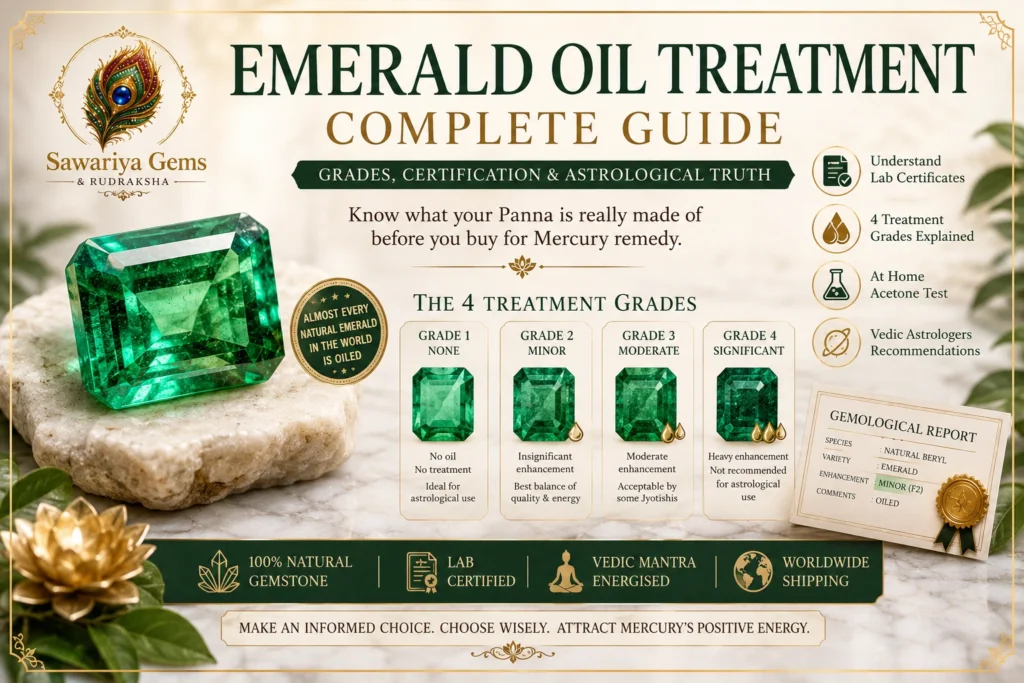
Almost every natural Emerald in the world has been oiled. This is not a secret in the gemstone trade — it is standard practice, openly documented on laboratory certificates, and widely accepted across the industry. What is not openly discussed, at least not by most Indian gemstone sellers, is what the different levels of oil treatment actually mean for a stone being purchased for astrological use — and whether a heavily oiled Emerald can do the same planetary work as an untreated one.
Panna Stone Oil Treatment explains the four treatment grades, how to read your laboratory certificate correctly, the acetone test you can perform at home, and what Vedic Jyotishis actually recommend when it comes to Panna treatment status. If you are considering a Panna purchase for Mercury remedy, read this before you buy anything.
Why Emerald Is Almost Always Oiled — the Geology Explanation
Panna — Emerald — is a variety of the mineral Beryl, coloured green by trace amounts of chromium and vanadium. Beryl is reasonably hard (Mohs 7.5 to 8) but Emerald specifically is almost always heavily included — meaning it contains natural internal fractures, fissures, and growth irregularities that formed as the crystal grew within the earth under enormous geological pressure.
These inclusions are so characteristic of Emerald that gemologists have a specific term for them: Jardin — French for garden — because the internal landscape of a natural Emerald often looks like a tangle of moss, vines, and leaves suspended within the green crystal. A completely inclusion-free Emerald is extraordinarily rare and commands prices far beyond the reach of most buyers.
The problem with these inclusions is practical: the surface-reaching fractures — fissures that extend from inside the stone to its outer surface — make Emerald more fragile than its hardness number suggests, and they reduce the stone’s visual clarity and brilliance. The solution the trade settled on centuries ago is to fill these surface-reaching fractures with a substance that has a similar refractive index to Beryl, making the fractures visually disappear and improving both the apparent clarity and the structural integrity of the stone.
That substance is traditionally cedarwood oil — hence the term “oiling” — though modern treatments also use synthetic resins, polymers, and other filling materials depending on the grade and origin of the stone.
The Four Treatment Grades — What Each One Means
Laboratory certificates — from GIA, IGI, Gübelin, or any reputable Indian lab — classify Panna Stone Oil Treatment into four grades. Understanding these four categories is the single most important thing you can do before purchasing Panna for astrological use.
Grade 1 — None (No treatment / F1 filling)
The certificate states: “No indications of clarity enhancement” or “None” in the enhancement field. This means no oil, no resin, no filler of any kind has been introduced into the stone’s fractures. These Emeralds are extraordinarily rare — they are mined with fractures that either do not reach the surface or are so minor that filling is unnecessary. An untreated Emerald of comparable colour and clarity to a treated one is worth dramatically more, often 3 to 5 times the price. In Vedic Jyotish, this is the ideal — a completely untreated Panna carries Mercury’s energy in its most undiluted form.
Grade 2 — Insignificant / Minor (F2 filling)
The certificate states: “Minor” or “Insignificant” enhancement. A very small amount of oil or resin has been used to fill minor surface-reaching fractures. The filling is so minimal that it has negligible effect on the stone’s overall appearance and structural integrity. Most serious Vedic Jyotishis consider Minor treatment fully acceptable for astrological use — the stone’s fundamental crystal structure and planetary energy are essentially intact. This is the most commonly available and most practically recommended grade for buyers seeking astrological Panna at a reasonable price point.
Grade 3 — Moderate (F3 filling)
The certificate states: “Moderate” enhancement. A meaningful amount of filler has been introduced into the stone’s fractures. The stone’s apparent clarity is significantly improved by the treatment — remove the filling and the stone would look noticeably less clean. Some Jyotishis accept Moderate treatment for astrological use, particularly if the stone’s colour is exceptional and the cost of an untreated or Minor stone is prohibitive. Others draw the line here, arguing that the significant filler presence interferes with Mercury’s energy transmission through the stone. This is a grey area in Vedic gemstone tradition and the recommendation varies by practitioner.
Grade 4 — Significant / Heavy (F4 or F5 filling)
The certificate states: “Significant,” “Heavy,” or “Prominent” enhancement. The stone has been extensively filled — in some cases, the fractures are so pervasive that the filling is holding the stone together as much as improving its clarity. Remove the filling from a heavily treated Emerald and what remains is often a crumbling, heavily fractured stone with minimal resemblance to what was purchased. In Vedic Jyotish, there is near-universal agreement: a significantly treated Emerald is not appropriate for astrological use. The planetary energy of Mercury cannot be transmitted effectively through a stone that is more filler than crystal.
How to Read Your Laboratory Certificate Correctly
This is where most buyers get confused — because the certificate language varies by laboratory and the terminology is not always intuitive.
Look for the field labelled: “Enhancement,” “Clarity Enhancement,” “Treatment,” or “Comments.” This field will contain one of the following categories of language:
Safe for astrological use:
“No indications of clarity enhancement” · “None” · “F1” · “No oil” · “Untreated” · “Minor” · “Insignificant” · “F2” · “Insignificant filling of surface-reaching fractures”
Requires Jyotishi assessment before purchase:
“Moderate” · “F3” · “Moderate filling of surface-reaching fractures” · “Minor to Moderate”
Not recommended for astrological use:
“Significant” · “Heavy” · “Prominent” · “F4” · “F5” · “Significant filling of surface-reaching fractures” · “Clarity-enhanced with resin”
If a seller cannot provide a laboratory certificate for a Panna stone they are selling for astrological purposes, or if the certificate does not address treatment status at all, that is a red flag significant enough to walk away from the purchase.
The Acetone Test — How to Check for Oiling at Home
This is the most practical home test for Emerald treatment, and it is simple enough to perform before purchasing a loose stone or even shortly after receiving one.
Acetone — the same chemical in nail polish remover — dissolves many of the organic oils and some of the resins used in Emerald treatment. When acetone contacts a treated Emerald, it begins to draw the filling material out of the stone’s surface-reaching fractures.
How to perform the test:
- Obtain pure acetone — nail polish remover that contains acetone works, though pure acetone from a hardware store gives cleaner results
- Place the loose Emerald stone in a small glass bowl — do not use plastic, as acetone dissolves many plastics
- Add enough acetone to cover the stone and leave it for 15 to 30 minutes
- Remove the stone and examine the acetone in the bowl, then examine the stone under good lighting
What the results mean:
If the acetone remains completely clear and the stone looks identical after soaking — the Emerald has not been oiled, or has been treated with a polymer resin that acetone does not dissolve. A GIA certificate is needed to distinguish between these two possibilities.
If the acetone turns slightly yellowish or oily, or if the stone looks slightly hazier or shows more visible fractures after soaking — the stone had cedarwood oil or a similar organic oil treatment. The degree of change gives you a rough indication of treatment level: barely perceptible change suggests Minor treatment, significant cloudiness or yellowing of the acetone suggests Moderate or above.
Important limitation: the acetone test does not detect polymer or resin treatments, which are increasingly common in modern Emerald trade. Only a laboratory certificate can definitively assess these. Use the acetone test as a first-pass indicator, not as a substitute for laboratory certification.
Jardin — Why Natural Inclusions Are Not a Defect in Panna
This deserves specific attention because it is the most common misunderstanding among first-time Emerald buyers, and it directly shapes the treatment-grade decisions they make.
The internal inclusions that characterise natural Emerald — the Jardin — are not defects to be apologised for. They are the fingerprints of the stone’s natural formation process, and in Vedic gemstone tradition they are one of the markers of authenticity that distinguishes a natural Panna from a synthetic one.
Synthetic Emeralds — created in laboratories — can be made without Jardin. They are chemically and optically identical to natural Emeralds but they carry no natural inclusion pattern, no geological history, and in Vedic Jyotish no planetary energy whatsoever. An Emerald that looks too clean, too perfect, and too inclusion-free for its price point is almost certainly synthetic. Natural Emerald of comparable visual clarity to a synthetic stone would cost dramatically more.
When a Jyotishi examines your Panna, they are not looking for the cleanest-looking stone — they are looking for a natural stone with its Jardin intact and its treatment level acceptable. The beauty of Panna lies in its living green depth, not in the glass-like perfection that signals synthetic origin or heavy filling.
Colombian vs Zambian Panna — How Origin Affects Treatment Grade
Origin is the second most important quality factor for astrological Panna, after treatment grade. The two most respected origins for Vedic astrological use are Colombia and Zambia — and they differ in ways that directly relate to the treatment question.
Colombian Emerald is considered the world standard for the finest Panna — the most saturated, pure green colour with the highest chromium content and the characteristic warm, slightly yellowish-green tone that distinguishes Colombian stones from all other origins. However, Colombian Emeralds also tend to be the most heavily fractured and therefore the most heavily treated. Finding a Colombian Panna with Minor or None treatment at an accessible price is genuinely difficult.
Zambian Emerald tends to have slightly cooler, more blue-green tones and typically contains fewer surface-reaching fractures — which means Zambian stones are more commonly available in Minor and None treatment grades at accessible prices. For buyers who need a Panna within budget for astrological use, Zambian stones in Minor treatment grade are often the most practical recommendation.
Brazilian and other origins are generally considered lower quality for Vedic astrological use — the colour tends toward yellowish-green or bluish-green rather than pure green, and the chromium content is lower, making them less optically vibrant and less astrologically potent.
What Vedic Jyotishis Actually Recommend
The traditional Vedic requirement for astrological Panna is straightforward: natural, untreated, eye-clean to slightly included, with a pure grass-green colour (Panna-varna in Sanskrit texts) and no significant surface-reaching fractures that would compromise structural integrity.
In practice, the modern consensus among knowledgeable Jyotishis is:
None treatment: ideal, use when budget permits and availability allows. Rare at accessible price points.
Minor treatment: fully acceptable for astrological use. The stone’s crystal structure and planetary energy are essentially intact. This is the realistic recommendation for most buyers seeking quality Panna within a practical budget.
Moderate treatment: acceptable with caveats. Some Jyotishis accept this grade for buyers where budget genuinely constrains the options, but a Moderate-treated stone of inferior colour is a worse choice than a Minor-treated stone of better colour. If choosing Moderate, ensure exceptional colour and natural clarity compensate.
Significant or Heavy treatment: not recommended for astrological use by any reputable Jyotishi. The stone has been so fundamentally altered from its natural state that meaningful planetary energy transmission is considered compromised.
For a full picture of Panna’s astrological role, Mercury’s domains, and how to wear it correctly with full ritual, use our free Janmpatri consultation — which assesses your Mercury placement and current Mahadasha before recommending treatment grade and weight.
Minimum Weight and Metal for Astrological Panna
Mercury’s gemstone needs to meet the same basic requirements as all Nav Ratan stones to be effective.
Weight: Minimum 3 Ratti (approximately 2.7 carats) for general Mercury strengthening. For Mercury Mahadasha (17 years — the second-longest of all Mahadashas), 5 Ratti or above for sustained support throughout the period.
Metal: Gold is traditional and preferred for Panna. Some Jyotishis also recommend Panchdhatu — the five-metal alloy — but gold is the stronger choice for Mercury stones specifically.
Finger: The Kanishtha — little finger — of the right hand. This is the consistent recommendation across all Jyotish traditions for Mercury’s gemstone.
Day: Wednesday (Budhvar) at sunrise during Shukla Paksha. Mercury’s day, Mercury’s planet, Mercury’s stone — the alignment between all three creates the most auspicious conditions for first wearing.
Frequently Asked Questions
Does all natural Emerald have oil treatment?
Almost all natural Emerald is treated to some degree — untreated Emeralds of good colour and clarity are extremely rare and command significant price premiums. The question is not whether your Panna has been treated but what grade the treatment falls into. Minor treatment is fully acceptable for astrological use; Significant or Heavy treatment is not recommended. Always ask for a laboratory certificate that specifically states the treatment grade before purchasing Panna for Vedic astrological use.
What does “F1, F2, F3” mean on an Emerald certificate?
These are GIA’s filling grade codes for Emerald clarity enhancement. F1 means no filling — the stone is untreated. F2 means minor or insignificant filling — acceptable for astrological use. F3 means moderate filling — a grey area that requires Jyotishi assessment. F4 and F5 mean significant to heavy filling — not recommended for astrological use. Always look for F1 or F2 when purchasing Panna for Mercury remedy.
How do I know if my Panna is synthetic?
Natural Emerald almost always contains characteristic internal inclusions called Jardin — a moss-like, tangled internal pattern visible under magnification. Synthetic Emeralds lack this natural inclusion pattern and appear remarkably clean and uniform inside. A completely inclusion-free Emerald at an accessible price point should raise immediate questions about natural origin. Laboratory certification confirming “natural” origin is the definitive test.
Can I wear Panna with Moderate oil treatment for astrology?
Opinion is divided among Jyotishis. Some accept Moderate Panna Stone Oil Treatment if the stone has exceptional colour and the buyer’s budget genuinely does not permit None or Minor treatment. Others draw the line at Minor. If Moderate is your only option within budget, choose a stone with outstanding pure green colour and confirm suitability with a Jyotishi who has examined the specific stone and certificate before purchase.
What is the difference between Colombian and Zambian Panna for astrology?
Colombian Emerald is considered the world standard — the most saturated pure green with the highest chromium content — but tends to be more heavily fractured and therefore more heavily treated. Zambian Emerald typically has slightly cooler green tones but is more commonly available in Minor and None treatment grades at accessible price points. For buyers who need quality astrological Panna within a practical budget, Zambian stones in Minor treatment grade are often the most realistic recommendation.
Does the acetone test work for all types of Emerald treatment?
No. The acetone test is effective for detecting organic oil treatments such as cedarwood oil and similar substances. It does not reliably detect polymer or synthetic resin treatments, which are increasingly common in the modern Emerald trade. Use the acetone test as a useful first-pass indicator, but always rely on a laboratory certificate from a reputable gemological lab for definitive treatment assessment.