Mahadasha in Vedic Astrology is one of the most searched and least clearly explained concepts in Vedic astrology for the general reader. People encounter the word constantly in Jyotish consultations, in astrology apps, and in explanations of why a particular period of their life has unfolded the way it has. Yet most explanations either assume so much prior knowledge that they leave the non-specialist reader more confused than before, or they simplify so heavily that the essential meaning is lost. This guide covers what Mahadasha actually is, how the system works, how to find out which Mahadasha you are currently in, what each of the nine planetary periods brings, and which gemstones and crystal bracelets provide the most appropriate support for each.
What Does Mahadasha Mean
Mahadasha comes from two Sanskrit words: Maha, meaning great or major, and Dasha, meaning planetary period or planetary condition. A Mahadasha is therefore a major planetary period, a stretch of years during which one specific Navagraha (planetary force) becomes the dominant influence shaping the quality, direction, and possibilities of a person’s life experience.
In Vedic astrology, time is not understood as a uniform flow in which one year is fundamentally like any other. Instead, life unfolds in distinct planetary chapters, each governed by a specific Navagraha whose nature, house placement, and relationship to other planets in the birth chart determines the texture and theme of that period. The planet ruling your current Mahadasha is the single most important factor for understanding what is happening in your life right now and why specific areas of life are expanding, contracting, or being tested during this period.
The Vimshottari Dasha System
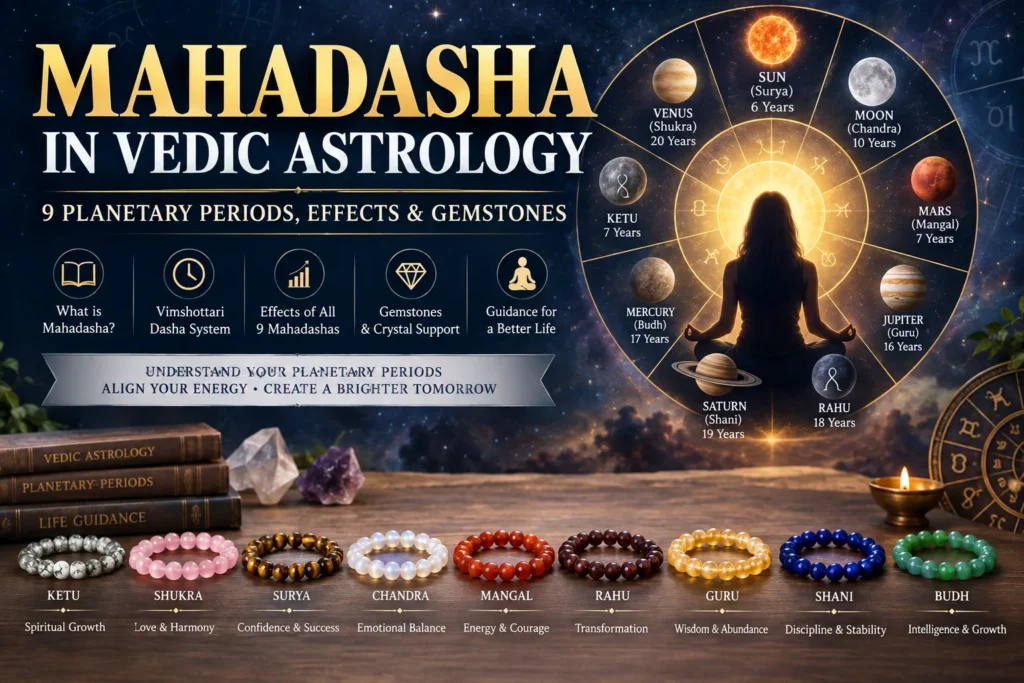
Several Dasha systems exist in Vedic astrology, but the Vimshottari Dasha system is by far the most widely used in both classical texts and contemporary Jyotish practice. Vimshottari means 120 in Sanskrit, referring to the total cycle length of 120 years that encompasses all nine planetary periods. The complete cycle is:
| Planet (Mahadasha Lord) | Sanskrit Name | Duration |
|---|---|---|
| Ketu (South Node) | Ketu Mahadasha | 7 years |
| Venus | Shukra Mahadasha | 20 years |
| Sun | Surya Mahadasha | 6 years |
| Moon | Chandra Mahadasha | 10 years |
| Mars | Mangal Mahadasha | 7 years |
| Rahu (North Node) | Rahu Mahadasha | 18 years |
| Jupiter | Guru Mahadasha | 16 years |
| Saturn | Shani Mahadasha | 19 years |
| Mercury | Budh Mahadasha | 17 years |
| Total | 120 years |
No person lives through all nine Mahadashas in a single lifetime because the starting point in the cycle is different for each individual, determined by the nakshatra (lunar mansion) in which the Moon was placed at the moment of birth. The Moon’s birth nakshatra determines which Mahadasha runs first and for how many years of it remain at birth (based on how far through that nakshatra the Moon had already moved).
How to Find Your Current Mahadasha
The simplest way to find your current Mahadasha is through an accurate Vedic astrology birth chart calculation, which requires your date of birth, time of birth, and place of birth. Most Vedic astrology apps and websites will calculate your Dasha sequence automatically once these details are entered. The Sawariya Gems free Janmpatri consultation includes Mahadasha assessment as part of the chart reading, which is the most reliable approach because a Jyotishi can assess not just which Mahadasha you are in but how that planet is placed in your specific chart and what the period is therefore likely to bring for you specifically.
The most important thing to know about finding your Mahadasha is that the time of birth matters significantly. An error of even one or two hours can place the Moon in a different nakshatra and produce an entirely different Dasha sequence. If your birth time is approximate or uncertain, a Jyotishi can often narrow it down through chart rectification based on known life events. Never trust a Mahadasha calculation based on an uncertain birth time without this rectification step.
All 9 Mahadashas: What Each Period Brings
Ketu Mahadasha (7 Years)
Ketu Mahadasha is the most spiritually intense and materially disruptive of all the planetary periods. Ketu is a Chhaya Graha (shadow planet), headless and oriented toward the past and the spiritual rather than the material and the future. This period typically involves significant releases: relationships, careers, identities, and material attachments that have been held beyond their genuine usefulness are stripped away, often in ways that feel abrupt and painful but that create the conditions for genuine spiritual development and the beginning of a more authentically aligned life. The experience of Ketu Mahadasha varies enormously depending on where Ketu sits in the birth chart, but its essential quality is always of dissolution and the emergence of deeper spiritual awareness through that dissolution. Read more in the complete Lehsunia (Cat’s Eye) guide.
Shukra Mahadasha (20 Years)
Shukra (Venus) Mahadasha is the longest and often the most materially abundant of the planetary periods. Shukra governs love, relationships, beauty, creative expression, material pleasures, and the quality of life’s aesthetic and sensory dimensions. A well-placed Shukra Mahadasha brings marriage, significant relationship development, financial abundance, creative success, and the expansion of beauty and pleasure in daily life. This is the period during which many people settle into their most important relationships, achieve their most significant creative work, and experience the material prosperity that Shukra’s generous abundance brings. Crystals: Rose Quartz, Green Aventurine, Moonstone.
Surya Mahadasha (6 Years)
Surya (Sun) Mahadasha is the shortest of the nine periods and one of the most important for career, authority, and public standing. Surya governs leadership, recognition, the relationship with the father, government and institutional connection, and the fundamental clarity of the Atma (true self). This period typically brings increased visibility and career development for those with a well-placed Surya, and challenges with authority figures, health related to the heart and spine, and identity crises for those with an afflicted Sun. Crystals: Tiger Eye (Vyaghra Mani), Citrine (Sunela).
Chandra Mahadasha (10 Years)
Chandra (Moon) Mahadasha places emotional life, mental peace, the mother relationship, home, and the quality of the inner emotional field at the centre of a decade-long experience. A well-placed Moon Mahadasha brings emotional richness, domestic happiness, popularity, strong intuitive intelligence, and deep nurturing relationships. A challenging Moon Mahadasha brings emotional turbulence, anxiety, sleep disturbance, troubled relationships with women, and the mind’s tendency toward worry and circular emotional processing. Crystals: Moti (Pearl), Moonstone (Chandrakant Mani), Milky Quartz (Dudhi Sphatik).
Mangal Mahadasha (7 Years)
Mangal (Mars) Mahadasha brings intensity, energy, ambition, and the drive to accomplish things quickly and forcefully. Surya Mahadasha raises the question of who you are in the world; Mangal Mahadasha raises the question of what you are going to do about it. A well-placed Mangal Mahadasha brings significant professional drive, physical vitality, competitive success, and the courage to pursue ambitious goals. A challenging Mangal Mahadasha can bring conflict, accidents, impulsive decisions with lasting consequences, and the friction that comes from Mars energy without adequate grounding. Crystals: Moonga (Red Coral), Tiger Eye, Carnelian.
Rahu Mahadasha (18 Years)
Rahu (North Node) Mahadasha is the most expansive, unconventional, and unpredictable of the major periods. Rahu is the planet of ambition, foreignness, innovation, technology, sudden events, and the breaking of conventional boundaries in pursuit of growth and experience. This period often brings unusual career opportunities, significant material expansion, and experiences that feel entirely outside the normal trajectory of a person’s life. The shadow side of Rahu Mahadasha is obsession, manipulation, confusion about identity and values, and the sudden reversals that follow when Rahu’s expansions have moved beyond genuine dharmic alignment. Crystals: Gomed (Hessonite Garnet). Read the complete Rahu Mahadasha guide.
Guru Mahadasha (16 Years)
Guru (Jupiter) Mahadasha is considered the most auspicious of all the planetary periods in classical Jyotish texts, and with good reason: Guru governs abundance, wisdom, dharma, teaching, children, higher knowledge, and the generous expansion of everything genuinely good in a person’s life. This period typically brings marriage, children, significant financial abundance, career recognition in wisdom and knowledge professions, and a deepening of spiritual understanding and philosophical clarity. Guru Mahadasha is the period during which many people experience their most significant life blessings. Crystals: Pukhraj (Yellow Sapphire), Citrine (Sunela).
Shani Mahadasha (19 Years)
Shani (Saturn) Mahadasha is the most demanding and the most karmically significant of all the planetary periods. Shani governs discipline, long-term effort, karma, service, and the slow, honest building of something genuinely valuable through sustained work rather than luck or talent alone. This period is rarely comfortable in its earlier phases, as Saturn’s testing nature brings the lessons that have been avoided, the karma that has been accumulated, and the structures of life that need to be rebuilt on a more honest foundation. In its later phases, Shani Mahadasha often produces the most lasting and genuinely earned achievements of a person’s life. Crystals: Neelam (Blue Sapphire) for appropriate Lagnas, Amethyst (Jamunia) for daily crystal support.
Budh Mahadasha (17 Years)
Budh (Mercury) Mahadasha brings intellectual activity, communication, commerce, learning, and the development of all the skills and relationships that Mercury governs. This period is particularly productive for education, writing, business, media, information technology, and any field where sharp analytical intelligence and clear communication are the primary professional assets. A well-placed Budh Mahadasha produces remarkable intellectual development and commercial success. A challenging Mercury period can bring nervous system issues, communication problems, and the anxiety that Mercury’s overactive analytical mind produces when it cannot find stillness. Crystals: Panna (Emerald) for appropriate Lagnas, Lapis Lazuli and Green Aventurine for daily crystal support.
Antardasha: The Sub-Periods Within Each Mahadasha
Each Mahadasha is divided into nine Antardashas (sub-periods), which run through all nine planets in the same Vimshottari order within the main period. This is why Jyotishis speak of being in, for example, “Shani-Rahu” or “Guru-Budh”; the first name is the Mahadasha (main period) lord and the second is the Antardasha (sub-period) lord. The Antardasha lord brings its own planetary flavour into the main period, creating the finer texture of experience within each major chapter. Understanding both the Mahadasha and the current Antardasha together provides the most accurate picture of a person’s current planetary experience.
Frequently Asked Questions
How do I know which Mahadasha I am currently in?
You need your complete Vedic birth chart with an accurate birth time. Most Vedic astrology apps (Astrosage, Jagannatha Hora, and others) calculate the Dasha sequence automatically from date, time, and place of birth. The Sawariya Gems free Janmpatri consultation includes Mahadasha assessment. The most important detail is an accurate birth time; an error of even a few hours can change the entire Dasha sequence. If your birth time is approximate, a Jyotishi can help rectify it through chart analysis.
Can two people born on the same day be in different Mahadashas?
Yes, absolutely. The Mahadasha sequence depends on the Moon’s nakshatra at birth, and the Moon moves approximately one nakshatra every day. Two people born on the same date but in different cities, or at different times of day, can have the Moon in different nakshatras and therefore entirely different Dasha sequences running at entirely different points in the 120-year cycle. This is one of many reasons why Vedic astrology emphasises birth time accuracy as the foundation of any reliable chart analysis.
Which Mahadasha is considered the best?
Guru Mahadasha (Jupiter’s 16-year period) is generally considered the most auspicious in classical Vedic texts, as Jupiter is the planet of abundance, dharma, wisdom, and the generous expansion of what is genuinely good. Shukra Mahadasha (Venus’s 20 years) is the most abundant in material pleasures and relationship development. However, the quality of any Mahadasha depends fundamentally on how that planet is placed in the individual’s birth chart, which house it rules, which planets it is associated with, and whether it is strong or afflicted. A well-placed Shani Mahadasha can produce more lasting achievement than a poorly placed Guru Mahadasha. The planet’s chart position always matters more than its general reputation.
How does a Mahadasha change affect daily life?
A Mahadasha transition is one of the most significant timing events in Vedic astrology. The changeover from one major planetary period to another typically brings a noticeable shift in the quality and direction of life over a period of months around the transition date. Old structures associated with the outgoing period often conclude or change form; new themes associated with the incoming period begin to emerge. The transition into Rahu, Ketu, or Shani Mahadasha from a more benevolent period is often felt most intensely. Gemstone changes are typically recommended at Mahadasha transitions by Jyotishis, switching from the outgoing period’s stone to the incoming period’s gemstone or crystal as the new chapter begins.
Should I change my gemstone when my Mahadasha changes?
This is a question for your Jyotishi rather than a fixed rule. In general, the Mahadasha lord’s gemstone supports the positive expression of the current planetary period, so switching to the new Mahadasha lord’s stone at the transition makes logical Vedic sense. However, the specific gemstone recommendation always depends on how the incoming Mahadasha lord is placed in your birth chart, which it rules, and whether strengthening that planet through its gemstone is beneficial for your specific Lagna. Use the free Janmpatri consultation at Sawariya Gems for guidance on which gemstone or crystal bracelet is most appropriate for your current Mahadasha.
This guide is for educational purposes based on the Vedic Jyotish tradition. Individual Mahadasha experiences vary significantly based on the specific planetary placements in each person’s birth chart. For accurate Mahadasha assessment and appropriate gemstone guidance, consult a qualified Jyotishi with your complete birth details.