Of all the Nav Ratan gemstones, Moonga is the one that produces the most immediate, physically felt change. People who wear genuine Red Coral consistently describe the same thing — a lift in energy that arrives within weeks rather than months, a return of the drive and decisiveness that had quietly gone missing, and a reduction in the fatigue that no amount of sleep had been fixing. Mars is the fastest-moving of the classical planets, and his stone reflects that — Moonga acts quickly, when it acts.
This guide covers what Moonga actually does, why it works for Aries and Scorpio specifically, how it addresses Mangal Dosha, how to identify genuine Red Coral from the fakes that dominate the market, and the exact ritual for first wearing.
What Is Moonga — the Stone That Comes from the Sea
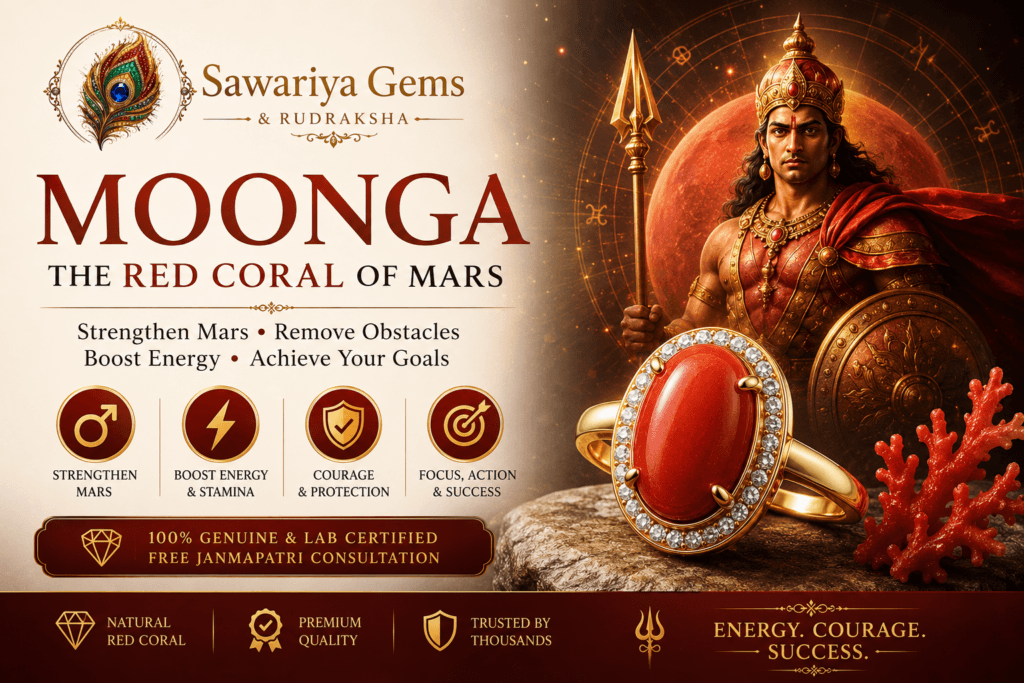
Moonga — Red Coral — is one of the few Nav Ratan gemstones that is not a mineral at all. It is organic — formed from the calcium carbonate skeletal remains of Praval, tiny marine polyps that live in colonies in warm ocean currents. Over years, these colonies build branching structures, layer by layer, in the same deep sea environments that also produce Pearl. When harvested, cleaned, and polished, the result is the characteristic deep red organic material that has been valued in Vedic, Chinese, and Mediterranean tradition for thousands of years.
This organic origin is important for two reasons. First, it is why Moonga has a specific surface texture — a very faint wood-grain-like pattern and small pits that are the legacy of its biological structure — quite different from the smooth, glassy uniformity of a mineral stone. Second, it is why the market is full of imitations. Dyed stone, bamboo coral, synthetic resin, and even plastic can all be made to look like Red Coral at first glance. The identification section below covers exactly how to tell the difference.
Moonga and Mars — What the Planet Actually Governs
To understand what Moonga does, you need to understand what Mars actually governs in a Vedic birth chart — and it covers more territory than most people realise.
Mangal is the commander. In Vedic cosmology he is Senapati — the general of the planetary army — and everything he rules reflects that quality: courage and decisive action, physical energy and vitality, the blood and muscles, initiative and the drive to pursue what you want without hesitation. He governs younger siblings, land and property, and the professions that require direct, physical, or confrontational engagement — military, police, surgery, athletics, engineering.
When Mars is strong and well-directed in a birth chart, the person moves through life with a particular quality — not aggressive, but decisive. Not impulsive, but quick to act when action is called for. Not confrontational, but unafraid of direct engagement when it is necessary. This is healthy Mars. It is the energy that starts businesses, completes difficult projects, defends what matters, and does not leave things half-done.
When Mars is weak, afflicted, debilitated (in Cancer), or combust, the same energy turns inward or fails to ignite at all. The person experiences chronic fatigue despite reasonable rest. They hesitate before action in situations that clearly call for it. Frustration builds without release. Blood-related health concerns may surface. Property matters stall. And in relationships, an afflicted Mars often manifests as either suppressed conflict that never fully resolves or explosive, disproportionate reactions to small provocations.
Moonga directly addresses all of these — not by suppressing Mars or making the person gentler, but by strengthening and refining the planet’s constructive expressions. The energy does not change direction; it clears.
Moonga Benefits — What Consistent Wearers Experience
Physical energy and vitality returning. This is almost always the first thing wearers notice and the most reliably reported benefit across the widest range of people. A kind of baseline tiredness — the kind that sits in the body independent of how much sleep you get — begins to lift within the first few weeks of consistent wearing. Mars governs the blood and the body’s vital force, and Moonga’s effect on this is felt before anything else changes.
Decisive action replacing hesitation. People who have been stuck in long periods of knowing what they need to do without being able to bring themselves to do it describe a shift in this pattern — not willpower exactly, but a loosening of whatever was holding the action back. Mars energy, when it begins to flow clearly, has a forward-moving quality that is hard to describe precisely but is felt unmistakably.
Reduced internal anger accumulation. Counterintuitively, strengthening Mars tends to reduce the chronic low-level irritability that an afflicted Mars produces — not increase it. This happens because the energy has somewhere to go. The frustration that was building without outlet begins to discharge through appropriate action rather than continuing to build internally.
Property and land matters moving. This is the most specific and most verifiable practical benefit Mars governs. People with long-stalled property transactions, disputed land matters, or real estate decisions that have been paralysed for months or years frequently report movement in these areas after consistent Moonga wearing.
Improved blood-related health. In Vedic tradition, Mars governs the blood and circulatory vitality. Some wearers with Mars-related health concerns report gradual improvement alongside conventional medical treatment. Always consult a doctor for health concerns — Moonga is a spiritual wellness practice, not a medical treatment.
Why Aries and Scorpio Specifically
Both Aries (Mesh Rashi) and Scorpio (Vrischik Rashi) are ruled by Mars in traditional Vedic Jyotish — making Moonga the primary ratna for both. But they experience Mars’s energy differently, and understanding this difference explains why Moonga affects them in distinct ways.
Aries is Mars’s diurnal (day) sign — the direct, outward, assertive expression of the planet. Mars in Aries acts without hesitation, moves toward goals with direct force, and rarely struggles with the initiation of action. Moonga for Aries strengthens this natural directness and clarity, supporting the ascendant lord’s energy throughout the person’s life as the foundation of their entire chart.
Scorpio is Mars’s nocturnal sign — the inward, strategic, depth-oriented expression of the planet. Mars in Scorpio works through investigation, persistence, and the willingness to go into difficulty rather than around it. Moonga for Scorpio supports this deeper, more sustained Mars quality — the endurance to stay engaged with complex, difficult situations long enough to actually understand and resolve them.
For both signs, Moonga as the ascendant lord’s stone is not optional or experimental — it is the foundational planetary remedy for the entire chart.
Moonga and Mangal Dosha — The Most Important Connection
This section deserves special attention because Mangal Dosha is the reason many people first encounter the word “Moonga” — and the relationship between the two is frequently oversimplified or misrepresented.
Mangal Dosha occurs when Mars is placed in the 1st, 2nd, 4th, 7th, 8th, or 12th house of the birth chart. The detailed explanation of what this means, how it manifests in relationships, and when it cancels itself is covered in our complete Mangal Dosha guide. For the purpose of this guide, the key point about Moonga’s role is this:
Moonga does not remove Mangal Dosha from the chart. Nothing removes a planetary placement from a chart — the birth chart is fixed at birth and remains as it is. What Moonga does is refine and channel Mars’s energy so that its expression in those houses becomes constructive rather than disruptive. The fire is still there — it is simply burning in a way that generates heat rather than burning down the house.
For Mangal Dosha cases specifically, most Jyotishis recommend higher Ratti — 6 to 9 Ratti rather than the standard 3 Ratti minimum — because the dosha represents a more concentrated, persistent Mars influence that requires proportionally stronger gemstone support.
Moonga Quality — What Actually Matters
Colour. The finest astrological Moonga has a deep, saturated red — sometimes described as Sinduri red or Ox-blood red. This pure, saturated red carries Mars’s energy most directly. Pale pink or orange-red stones are lower grade. Very dark, brownish-red coral is also lower quality. The colour you want looks like concentrated red — vivid, warm, and present without being brown or faded.
Origin. Italian Red Coral from the Mediterranean — particularly from the waters around Sardinia and the Strait of Sicily — is the most prized for astrological use, valued for its pure, deep red colour and the uniformity of its tone. Japanese coral is also respected. Australian and Indian ocean coral tends toward lighter pink-red and is considered lower grade for astrological purposes.
Shape. Traditional Jyotish texts specify triangular or oval Moonga as particularly auspicious for Mars. This is not merely preference — the triangular shape is associated with Agni (fire), the deity of Mars, and is considered especially effective for Mangal Dosha remedy. Cylindrical and round shapes are also used but considered less astrologically specific.
Carat weight (Ratti). Minimum 3 Ratti (approximately 2.7 carats) for general Mars strengthening. For Mangal Dosha, 6 to 9 Ratti. The formula many Jyotishis use is 1/12th of body weight in kilograms — a 60kg person wears approximately 5 Ratti.
How to Identify Genuine Moonga — The Tests That Work
The Red Coral market has a significant proportion of imitations — dyed howlite, bamboo coral, synthetic resin, and plastic — because genuine Italian Red Coral commands a meaningful price and the visual similarity to imitations is close enough to mislead buyers who do not know what to look for.
The vinegar test. This is the most reliable home test for coral. Place a small drop of white vinegar or dilute acid on an inconspicuous part of the stone. Natural coral — calcium carbonate — will react with the acid and fizz gently, producing tiny bubbles. Plastic, resin, and glass imitations will not react at all. This is a non-destructive test that can be performed on a loose stone before setting.
Surface texture. Natural coral has a characteristic organic surface — a very faint wood-grain-like pattern of parallel lines and tiny natural pits that are the residue of its biological structure. Under close inspection or a 10x loupe, this texture is clearly different from the perfectly smooth surface of resin or plastic. Glass imitations look too uniform, too perfect, and too consistent in colour depth.
Bamboo coral detection. Bamboo coral — a different marine organism — is frequently dyed red and sold as Moonga. The key difference under magnification is the internal structure: bamboo coral has long, parallel grain lines running through the bead, similar to the grain in wood. Genuine Praval (coral polyp coral) has a honeycomb-like internal cellular structure rather than parallel graining.
Weight. Genuine coral feels lighter than glass or stone imitations of the same size. Plastic feels even lighter than genuine coral. If your coral bead feels as heavy as a gemstone, it may be dyed stone rather than genuine coral.
All Sawariya Gems Moonga stones are laboratory certified for natural origin, species identification, and no artificial dye treatment.
How to Wear Moonga — Complete Ritual
Metal: Gold is most effective for Mars stones. Panchdhatu is also suitable. Copper is sometimes specifically prescribed for Mangal Dosha cases — confirm with your Jyotishi for your specific situation.
Finger: The Anamika — ring finger — or Tarjani — index finger — of the right hand. Ring finger is the more common recommendation. Some Jyotishis prescribe index finger specifically for Mangal Dosha cases — confirm for your chart.
Day and time: Tuesday (Mangalvar) at sunrise during Shukla Paksha. This is the most consistent recommendation across all Jyotish traditions for Moonga specifically.
First wearing ritual:
- Bathe on Tuesday morning before sunrise or just after
- Place the ring in a small bowl with Ganga jal, honey, and Tulsi leaves — soak for 20 minutes
- Sit before a Hanuman image — Hanuman is the deity most associated with Mars in Vedic tradition
- Chant Om Kraam Kreem Kraum Sah Bhaumaya Namah — 108 times
- Offer red flowers to Hanuman ji
- Touch the ring to your forehead, then wear on Anamika or Tarjani of the right hand
Reciting Hanuman Chalisa on Tuesdays alongside wearing Moonga is considered one of the most powerful combined practices for Mars remedy and Mangal Dosha work — the devotional practice and the gemstone remedy reinforcing each other.
Pair It With
For the complete Mars planetary cluster — gemstone and Rudraksha together — Moonga pairs with the 3 Mukhi Rudraksha. The 3 Mukhi addresses the fire deity Agni and the karmic, psychological roots of Mars affliction — anger, guilt, and unresolved past action — while Moonga addresses the planetary energy directly. Together they form a complete Mars remedy from two different traditional approaches.
For those who are Aries born and also need Jupiter’s blessing alongside Mars — confidence and wisdom, drive and good fortune — Moonga pairs naturally with Yellow Sapphire (Pukhraj). Sun and Jupiter are both friendly to Mars, making this one of the most auspicious two-stone combinations for Mesh Rashi.
Explore the full Navaratna gemstone collection or use our free Janmpatri consultation to assess your specific Mars placement before purchasing.
Frequently Asked Questions
Who should wear Moonga (Red Coral)?
Moonga is primarily recommended for Aries (Mesh Rashi) and Scorpio (Vrischik Rashi) born — both Mars-ruled signs. It is also recommended for anyone in Mangal Mahadasha (7 years), those with Mangal Dosha in their birth chart, and people with weak, debilitated, or combust Mars creating chronic fatigue, hesitation, or property-related obstacles. A free Janmpatri reading confirms suitability for your specific chart.
Which finger for Moonga?
The Anamika (ring finger) of the right hand is the standard recommendation. Some Jyotishis prescribe the Tarjani (index finger) for specific Mangal Dosha configurations — confirm for your chart. Set in gold or Panchdhatu, first worn on Tuesday at sunrise during Shukla Paksha.
How many Ratti of Moonga for Mangal Dosha?
For Mangal Dosha specifically, 6 to 9 Ratti is the standard recommendation — higher than the 3 Ratti minimum for general Mars strengthening. The dosha represents a more concentrated, persistent Mars influence that requires proportionally stronger gemstone support.
How do I identify genuine Red Coral?
The most reliable home test: place a small drop of white vinegar on the stone. Genuine coral fizzes gently — calcium carbonate reacts with acid. Plastic, resin and glass imitations do not react at all. Natural coral also has a faint wood-grain surface texture under close inspection, unlike the perfectly smooth surface of imitations.
Does Moonga make a person more aggressive?
No — and this is one of the most common misconceptions about Mars stones. Strengthening Mars through Moonga does not increase aggression. It channels Mars’s energy into its constructive expressions — courage, decisiveness, and the ability to act when action is called for. The chronic irritability that comes from an afflicted Mars actually tends to reduce with Moonga wearing, because the energy has somewhere to go through appropriate action rather than building internally.
Can I wear Moonga with Pukhraj (Yellow Sapphire)?
Yes — Mars and Jupiter are naturally friendly planets in Vedic astrology. For Aries born especially, Moonga and Pukhraj together create a powerful combination. Read our complete Pukhraj guide for the Jupiter side of this pairing.